lunes, 12 de junio de 2017

Rafael Nadal revels in the instant history of ‘a perfect Roland Garros’

Resultado de imagen de nadal roland garros 2017 trophyAn emotional Rafael Nadal described his 10th French Open title as the perfect end to a perfect fortnight after he made history at Roland Garros on Sunday. The 31‑year‑old Spaniard’s 6-2, 6-3, 6-1 victory against Stan Wawrinka of Switzerland made him the first man to win any of the grand slam events 10 times, a feat he achieved without dropping a single set.
“This has been, I think, a perfect Roland Garros for me,” said Nadal, who dropped just 35 games in total on his way to a 15th grand slam title but his first for three years.
Nadal was shown a montage of his 10 victories before the trophy presentation and said the historic nature of the triumph added to his satisfaction. “It is true that this one is going to be one of the more special for the number, for what happened on the ceremony after the final, for so many things,” he said. “And because I am 31 already and not a kid any more. Today was a very important day for me. [There] have been some tough moments last times, injuries, so it’s great to have big success like this again.” Nadal said when he first won the title in 2005 he would not have imagined he would still be playing in 2017, let alone winning, and said 10 titles had a special ring to it. “As I like to say, if I can do it, someone else can do it,” he said. “But you need the right circumstances, the right ingredients to win 10 French Open titles. I don’t know if I will ever get to meet the player who will do better than I did. It has been very special to me, and it’s true that it is unprecedented. Trust me, I’m very happy that I’m the one who did it. I’m very happy.”
Wawrinka, who lost a grand slam final for the first time, said he had been beaten by a man at the peak of his game. “For sure he’s playing the best he’s ever played,” Wawrinka said. “But not only here. I think since the beginning of the year, you can see he’s playing more aggressive, staying more close [to] the line. But that’s clearly the best he has ever played. That’s why he’s winning so much again.”
Advertisement
The Swiss said he had recovered well physically from the effort of defeating Andy Murray in a semi-final which lasted more than four and a half hours, but that mentally the efforts of the past few weeks had caught up with him.
“From the beginning from my side, for sure, I didn’t play my best tennis,” he said. “I think I was a little bit hesitating with my selection of shots. I was always a little bit between [thoughts]. One, because I play against him and he puts this doubt in your head when you play against him because he’s playing so well. And second, all the effort I have been doing [in the] last few weeks to get to my best level again, to get some confidence again, and to win all those matches … some tough matches.”
Wawrinka said the positives of the fortnight outweighed the negatives of losing a grand slam final, having shrugged off a poor clay-court season to make the final for the second time in three years. Nadal’s 10th win, he said, was an incredible achievement. “It’s something tough to describe when you just say you won 10 French Opens,” he said. “It’s a grand slam, but it’s the same grand slam. That’s something so big for the sport. He’s the best-ever player on clay.”
Nadal said his chances at Wimbledon, where he has not won since 2010, depended on how his aching knees respond on the grass. “If I have pain in the knees, then I know from experience that it’s almost impossible,” he said. “Because I need to feel strong, low and powerful legs to play well in Wimbledon. If I don’t feel that, then probably my chances are not there, no? But if I am healthy and I am able to have the right preparation and feel healthy during Wimbledon, then I am probably going to have my chances to play well.”

                                                                                                                          The Guardian 12/6/2017

The man who helped prevent a nuclear crisis

In 1988 Taiwan was racing to build its first nuclear bomb, but one military scientist put a stop to that when he defected to the United States and exposed those plans. This is the story of a man who insists he had to betray his country in order to save it.
To this day, critics consider Chang Hsien-yi a traitor - but he has no regrets.
"If I can ever do it all over again, I will do it," says the calmly defiant 73-year-old, speaking from his home in the US state of Idaho.
The former military colonel has been living there since 1988 when he fled to the US, a close ally of the island, and this is his first substantial interview about that time.
It might seem a perplexing turn of events given the close relationship the US has with Taiwan, but Washington had found out that Taiwan's government had secretly ordered scientists to develop nuclear weapons.
Taiwan's enemy, the Communist government of China, had been building up its nuclear arsenal since the 1960s, and the Taiwanese were terrified this would be unleashed on the island.
Taiwan separated from China after the Chinese Civil War in 1949. To this day China considers Taiwan a breakaway province and has vowed to reunify with the island, by force if necessary.

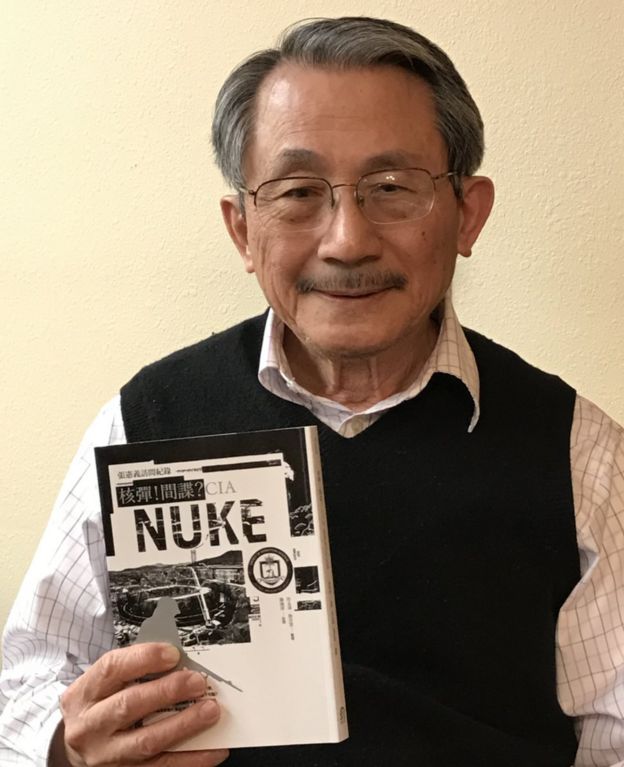
Picture of Chang Hsien-yi with his book Nuclear! Spy? CIA: Record of an InterviewThe leadership of the island was also in an uncertain phase - its president, Chiang Ching-kuo, was dying, and the US thought that General Hau Pei-tsun, whom they saw as a hawkish figure, would become his successor.
They were worried about a nuclearisation of the Taiwan Strait and bent on stopping Taiwan's nuclear ambition in its tracks and preventing a regional arms race.
So they secretly enlisted Mr Chang to halt Taiwan's programme.
When Mr Chang was recruited by the CIA in the early 1980s, he was the deputy director at Taiwan's Institute of Nuclear Energy Research, which was responsible for the nuclear weapons programme.
As one of Taiwan's key nuclear scientists, he enjoyed a life of privilege and a lucrative salary.
But he says he began questioning whether the island should have nuclear weapons after the catastrophic Chernobyl accident in 1986 in the former Soviet Union.
He was convinced by the Americans' argument that stopping the programme would be "good for peace, and was for the benefit of mainland China and Taiwan".

"This fit into my mindset very much," says Mr Chang. "But the most important reason why I agreed is that they went to great efforts to assure me they would ensure my safety."
The next task was getting him and his family out.

Defection

At that time, military officials could not leave Taiwan without permission.
So, Mr Chang first ensured his wife and three young children's safety by sending them to Japan for a holiday.
His wife, Betty, says she had no clue about her husband's double life. They had only talked about the possibility of him accepting a job in the US.
"He told me this was a trial to test how easy I could get out from Taiwan and to see how much luggage I could pack," she says.
Mrs Chang left on 8 January 1988 with their children, excited to visit Tokyo Disneyland.
The very next day, Mr Chang took a flight to the US using a fake passport provided by the CIA. All he had with him was some cash and a few personal possessions.
Contrary to previous reports, he says he did not take a single document with him when he left Taiwan.
"The American government had all the evidence, they just needed someone - me - to corroborate it."
Meanwhile in Tokyo, Betty Chang was approached by a woman who handed her a letter from Mr Chang. That was the moment she discovered her husband was a CIA spy and had defected.
"It said 'You will never go back to Taiwan and from Japan you will go to USA'... that was a surprise for me.
"I just cried when I knew I could no longer go back to Taiwan," says Mrs Chang.
The family was bundled into a plane headed for Seattle, where they were met by Mr Chang at the airport.
The Changs were later put in a safe house in Virginia, due to fears he would be assassinated by Taiwanese agents or patriotic extremists.
Within a month, the US succeeded in pressuring Taiwan to end the programme, using the intelligence it had collected and Mr Chang's testimony.
Taiwan was believed to be just one or two years from completing a nuclear bomb.

Setting the record straight

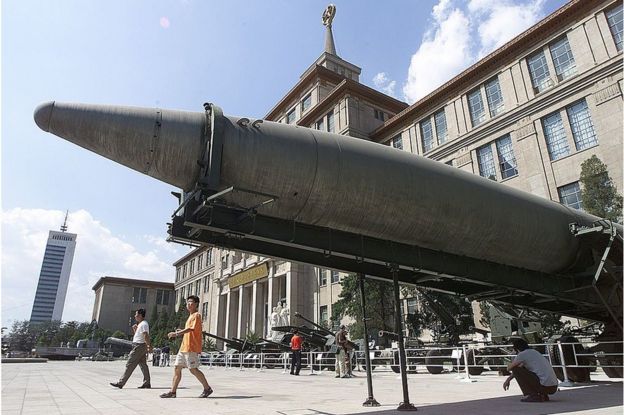
A missile sits on display in the courtyard of the Military Museum in Beijing, 5 September 2001.Mr Chang has remained silent for decades. But with his recent retirement he now wants to set the record straight with a memoir, titled Nuclear! Spy? CIA: Record of an Interview with Chang Hsien-yi.
The book, written with academic Chen Yi-shen and published in December, has reignited a debate about whether Mr Chang did the right thing for Taiwan.
Some praise him for preventing a potential nuclear war. Others see his actions as denying Taiwan the weapons it needed for self-defence and survival.
Even those in Taiwan's ruling Democratic Progressive Party (DPP), which officially opposes the development of nuclear energy and weapons, take a dim view of Mr Chang's actions.
"Regardless of what your political views are, when you betray your country, it's not acceptable... it cannot be forgiven," said the DPP's Wang Ting-yu, chairman of the parliament's foreign affairs and defence committee.
But Mr Chang insists he feared then that ambitious Taiwanese politicians would use nuclear weapons to try to take back mainland China.
He claims Madame Chiang Kai Shek, the stepmother of dying President Chiang Ching-kuo, and a group of generals loyal to her had even gone so far as to set up a separate chain of command to expedite the development of nuclear weapons.
"They said they wouldn't use it, but nobody believed it," says Mr Chang, adding that the US certainly did not.
Nowadays, there may still be politicians who could be tempted to use such weapons, this time to pursue Taiwan's formal independence from China at whatever cost, he says.
But the DPP's Mr Wang dismisses this notion. "We absolutely don't consider this, we don't even think about it," he said.
Over the years some Taiwanese presidents have hinted at a desire to reactivate the island's nuclear weapons programme, but these suggestions have been quickly quashed by Washington's objections.
Still, the island is widely considered to have the ability to make nuclear weapons quickly if needed. China has in recent years threatened to attack if Taiwan ever deployed nuclear weapons.

'I love Taiwan'

Following his defection, Taiwan's military listed Mr Chang as a fugitive. But even after his arrest warrant expired in 2000, he has not returned to Taiwan and does not plan to.
He does not want to deal with criticism he is sure he would face, and the negative impact that would have on his family there.
In 1990, they were permanently resettled in Idaho, where Mr Chang worked as a consulting engineer and scientist at the US government's Idaho National Laboratories until he retired in 2013.
He says his only regret is that he was not able to see his parents before they passed away.
"You don't have to be in Taiwan to love Taiwan; I love Taiwan," says Mr Chang.
"I am Taiwanese, I am Chinese. I don't want to see Chinese people on both sides of the Taiwan Strait killing each other."

                                                                                                                                               BBC News


viernes, 9 de junio de 2017

Ignacio Echeverría. Rest in peace.

Yesterday evening Ignacio was paid homage at Las Rozas, the town where he was brought up. Nearly a thousand people attended and showed their respect and admiration to a good man, someone who was ready to defend someone he didn't even know and who was being attacked by one of the London terrorist. He lost his life while trying to save another person. There is still hope for the human race.

From Las Rozas Official School of Languages where he studied some years ago, we want to express all our admiration and respect, and our deepest condolences and love to his family.


Homenaje a Ignacio Echeverría, este jueves en Las Rozas (Madrid), donde reside su familia y vivió él antes de trasladarse a Londres

London attack: Spaniard Ignacio Echeverría confirmed dead


The family of Ignacio Echeverría, who went to help a woman as she was stabbed by the attackers at London's Borough Market, has announced his death.
He was last seen trying to defend the woman with his skateboard.
After several days waiting for information, his brother and two sisters said he was dead.
"We want to see and be with Ignacio's body," his sister Ana said. "It seems we won't be able to be with his body before Friday at the earliest."
His other sister, Isabel, went on social media to praise his heroism and said he would never be forgotten.
"My brother Ignacio tried to stop the terrorists and lost his life trying to save others," she said.
As the number of people killed by the attackers on 3 June rose to eight, Prime Minister Mariano Rajoy praised the Spanish victim's "heroic and exemplary act" and said he had recommended that he be awarded posthumously an order of civil merit.
The foreign ministry in Madrid said he was a model of solidarity for everyone. "His bravery in standing up for a defenceless person is a reminder of the need to remain united in the face of the scourge of terrorism."
For days, the family heard nothing of Ignacio Echevarría's fate. Spain's Interior Minister Juan Ignacio Zoido described the identification process as strange and "inhumane" for the family.
Aged 39 and from Madrid, Ignacio Echevarría had been working for HSBC in London as part of the bank's team fighting money laundering.
As the three London Bridge attackers went on the rampage, his family said he was returning from an evening of skateboarding in a nearby park with friends.
He jumped off his bike and used his skateboard to hit one of the attackers who was stabbing a woman. The two others then attacked him from behind and he was last seen lying on the ground, the family said.
BBC News

«Algo muy triste y muy duro se está convirtiendo en algo más bonito y muy grandioso que nos hace querer más, apreciar más a nuestro hermano, a nuestra familia, a nuestros amigos y a nuestro país»Ana Echeverría

lunes, 5 de junio de 2017

Cloze test part 2 & Reading comprehension key

 If you want to do the second part of the cloze test, click here to get the exercise and the key:
Cloze test_part 2
 

An finally check the key to the last 2 reading comprehension exercises I gave you in class.


KEY TO THE READING COMPREHENSIONS         
The language of Hollywood
1 – C, 2 – C, 3 – A, 4 – B, 5 – A, 6 – B, 7 – A, 8 – B, 9 – A, 10 – A, 11 – C, 12 – A
Hans Sloane and the British Museum
1 – B, 2 – C, 3 – B, 4 – A, 5 – C, 6 – B, 7 – C, 8 – A, 9 – B, 10 – C


Simple way to boost cancer survival rates: diet and exercise, studies say


Studies of colon and breast cancer patients link healthy habits to better outcomes amid slew of research on lifestyle and cancer

A healthy diet and exercise could reduce colon cancer patients’ chance of death and simply walking could improve survival rates for breast cancer survivors, studies presented at the world’s largest cancer conference have found.
A study of nearly 1,000 colon cancer patients found that those who exercised regularly, ate more fruits and vegetables and avoided refined grains and meats had a 42% lower chance of death after seven years.
Similarly, a study of more than 300 Australian breast cancer survivors who aimed to exercise for 180 minutes per week – most by simply walking – had far better rates of survival than those who were not part of an exercise program.
The studies were presented amidst a slew of research on the impact of a healthy lifestyle on cancer, presented at the American Society of Clinical Oncology (ASCO) in Chicago.
“Most of what we know about the importance of exercise post-cancer comes from studying women with breast cancer,” said Sandra Hayes, an epidemiologist studying cancer and exercise at Queensland University of Technology in Australia.
Studies conducted on the relationship between exercise and other types of cancer, she said, held up a general set of findings.
“Engaging in some activity [or] exercise is better than none, and doing more is generally better than less,” Hayes said.
Researchers acknowledged that studies on the effects of exercise and cancer recurrence remain epidemiological, and that causal links are yet to be established. Further, the mechanisms through which exercise may influence cancer survival remain “unclear”.
In one study, researchers at the University of California San Francisco and colleagues aimed to test whether American Cancer Society (ACS) nutrition and exercise guidelines for cancer survivors could impact survival among colon cancer patients.
In general, the guidelines recommend moderate exercise of 150 minutes per week, eating a diet rich in whole grains, fruits and vegetables, and keeping a healthy body weight. The ACS has detailed guidelines for nutritional and exercise standards for cancer survivors, addressing everything from exercise to eating recommendations forthose who have little appetite.
Researchers found that even colon cancer survivors who drank moderately while following other guidelines had a 42% lower chance of dying than those that did not.

If you want to read the whole article in The Guardian, click here:

viernes, 2 de junio de 2017

Spain's 'lazy' young told by judges to get a life

Read this interesting article about some young Spanish people who expect to get their parents' economic support for ever and what some judges decide about it.

Spain's lazy young told by judges to get a life

Stock picture of young person at home