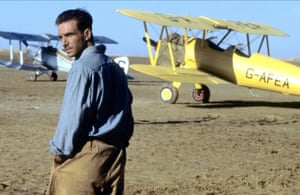
Read this interesting article in The Guardian about reading. You have here an extract:
In her own forthcoming work,Why You Should Read Children’s Books, Even Though You Are So Old and Wise, Rundell argues that children’s literature offers unique insights and distinctive imaginative experiences to adults. “Defy those who would tell you to be serious,” she writes, “those who would limit joy in the name of propriety. Cut shame off at the knees... Plunge yourself soul-forward into a children’s book: see ifyou do not find in them an unexpected alchemy; if they will not un-dig in you something half hidden and half forgotten.” Essential reading
I'm sure you'll enjoy it.
‘It's the book that gave me freedom’: Michael Ondaatje on The English Patient
The novel has been translated into 38 languages and the film scooped nine Oscars. Now, as The English Patient wins the Golden Booker prize – voted readers’ favourite in 50 years – the author reveals why he could never have been a writer if he’d stayed in Britain
n Sunday night, Michael Ondaatje stepped on to the wide stage of the Royal Festival Hall in London. He found a lectern and, white head bowed, reached into his pocket for a small piece of paper. “It began with a small night conversation between a burned patient and a nurse,” he said. “I did not know at first where it was taking place, or who the two characters were. I thought it might be a brief novella – all dialogue, European-style, big type.”
The audience laughed. Because what actually turned up, of course, was The English Patient: 300-plus pages about four people inhabiting the mined rooms of a remote Italian villa at the end of the second world war; four very different people who meet in damaged solitude, who talk (there are a lot of night conversations), who love, whose histories, revealed in vivid flashes, become a taut, outraged meditation on the idea of war, of nationalism and of prejudice; a meditation that slips between spies and explorers, Suffolk and the Egyptian desert; the Punjab and Women’s College Hospital, Toronto, as easily as the sapper, Kip, slips into bomb craters to defuse bombs.
The English Patient shared the Booker prize with Barry Unsworth’s Sacred Hunger in 1992, has been translated into 38 languages, and in 1996 became an Anthony Minghella-directed film winning nine Academy awards, and grossing $231m worldwide to date. By Sunday night it had been shortlisted for the Golden Man Booker 50: the best Booker winners of the last 50 years, arrived at by decade. Ondaatje’s competition was VS Naipaul, for In a Free State (1970s), Penelope Lively’s Moon Tiger (80s), Hilary Mantel’s Wolf Hall(2000s), and George Saunders’ Lincoln in the Bardo (10s). And, after a public vote, The English Patient won.
Upstairs, in a room with long views of a Thames blurry with heat, Ondaatje accepts congratulations and a glass of “white wine, please. My first in months.” He has one of the most recognisable faces in literature: pale eyes sharp in a wide, tanned face, a halo of white hair and beard. He is gracious, quick and thoughtful, but also well-defended, steely and distracted; aware of friends waiting to celebrate with him downstairs, he talks faster and faster, and eventually simply stops.
What an extraordinary afterlife the book has had. “Well, it already had a second afterlife with the film, right? And that was a bolt of lightning that I wasn’t expecting. And then this – suddenly redoing the whole thing again. Another horse race, you know?” He laughs. Though both were a fillip, really, on what the first prize gave him, which was the most precious thing: “Freedom. I had been teaching for many, many years up to that point.” Teaching full-time, in fact, and “trying to write a complicated novel”, and that had become too much to manage. “I thought I was going to lose it – and I had quit my job. I just needed to finish the book. It was a bet.” Which could not have come off more handsomely.
, in her speech earlier in the evening, had mused about how different a person she was, at 85, from the one who in her mid-50s had written Moon Tiger. What did Ondaatje think of the self who wrote The English Patient (which he has not reread since it was published)? “Well, I still like him.” More interesting, he thinks, is the way in which each book he’s written is like “a time capsule”.
When he was writing The English Patient, between about 1985 and 1992, there was an argument going on in Canada about nationalism and integration. “They didn’t want Sikhs to wear turbans if they were policemen and stuff like that. That was in the air.” The striking thing is how contemporary his concerns – how to release oneself from the imposition of nationalism; how to rediscover one’s essential individuality or true, often artistic allegiances – now feel. Contemporary, and somehow, in a harsher time, impossibly idealistic.
Penelope Lively, in her speech earlier in the evening, had mused about how different a person she was, at 85, from the one who in her mid-50s had written Moon Tiger. What did Ondaatje think of the self who wrote The English Patient (which he has not reread since it was published)? “Well, I still like him.” More interesting, he thinks, is the way in which each book he’s written is like “a time capsule”.
When he was writing The English Patient, between about 1985 and 1992, there was an argument going on in Canada about nationalism and integration. “They didn’t want Sikhs to wear turbans if they were policemen and stuff like that. That was in the air.” The striking thing is how contemporary his concerns – how to release oneself from the imposition of nationalism; how to rediscover one’s essential individuality or true, often artistic allegiances – now feel. Contemporary, and somehow, in a harsher time, impossibly idealistic.
I told you I had written to Corban Adisson, the author of The Garden of Burning Sand and he has replied!!
I'd like to share his message with all of you, as you are mentioned in his message. Hola Maria!
I wish I still had the vocabulary to
reply to you in Spanish, but, alas, I haven’t spoken it in many years.
Thanks so much for your lovely note. I’m honored that you used Garden in
your English class, and I’m delighted to hear about your students’
response. What you described is precisely what I hoped to achieve with
the book. All of us spend most of our lives in our own little worlds,
not knowing or having reason to care about what is happening to so many
people in other places around the globe. Our world is getting smaller
thanks to travel and technology, but the stories of individual people so
often escape us in the rush of our daily lives. The beauty of a novel
is its invitation to set aside the world we know, the world we’re
comfortable with, and enter another world, to walk a mile in the shoes
of someone else. I’m so glad that Garden offered that opportunity to you and your students.
Please
give your class my best, and please do let me know what you think of my
other stories. You should be able to get all of them from your
English-language bookstores in Madrid, especially the most recent one, A Harvest of Thorns.
I wish you all the best!
Corban
And this is his latest book, the one he suggests. Would you like to give it a try?
Watch this short video to get to know why the author decided to write this thought-provoking book.
And, if you are interested, you'll be able to find some other interesting thoughts and information about his other books and stories in this link to his webpage: