Mostrando entradas con la etiqueta grammar. Mostrar todas las entradas

jueves, 13 de diciembre de 2018

Order of adjectives


ORDER OF ADJECTIVES


SIZE (large, small)
OTHER QUALITIES/OPINION (fresh, frothy, delicious)
AGE (old, new)
SHAPE/PATTERN/COLOUR (black, cream)
ORIGIN/PLACE (Italian)
MATERIAL (leather)
PURPOSE (drinking)
TYPE (espresso)
+ NOUN

Example: A lovely, big, new, yellow, Spanish, cloth beach bag


Put these adjectives in the correct order:

A
south-westerly
frightening
gale

A (n)
weather-beaten
hunter’s
interesting
face

A
threadbare
winter
grey
woollen
coat

A
Chinese
ancient
tiny
carving

Mottled
attractive
blue
ceramics
Spanish
tiles

A
huge
slightly damaged
Victorian
oak
chest of drawers

green
English
breath-taken
countryside

A
Dutch
18th century
sombre
landscape
faded
painting

A
white
uncomfortable
cycling
plastic
helmet

A
evening
spicy
delicious
Italian
colourful
meal

A
fresh
black
espresso
delicious
Italian
coffee

And the click here so see the key:   Order of adjectives in English

jueves, 29 de noviembre de 2018

WOULD - different uses and key to exercises


                  WOULD

1. To express unlikely or unreal situations:
Ex. We wouldn’t be here if we had taken the right train.

2. To express a past hypothesis or regret:
Ex. I wouldn’t have failed if I had worked hard.

3. To express habitual past with active verbs:
Ex. As a child, I’d walk to school every day.

4. To express the future in the past:
Ex. She met the man she would one day marry.

5. To express a refusal:
Ex. The car wouldn’t start.

6. To give advice:
Ex. If I were you, I’d stop smoking now.

7. To introduce cautious opinions:
Ex. I’d say / I’d imagine he is a good colleague.

8. To make polite requests, and express wants and preferences:
Ex. Would you mind opening the window?
I’d like to leave now. I’d prefer to go by train.

9. Past of will (often in reported speech):
Ex. She said she would come.

Key to exercises:


viernes, 6 de julio de 2018

Other or another?

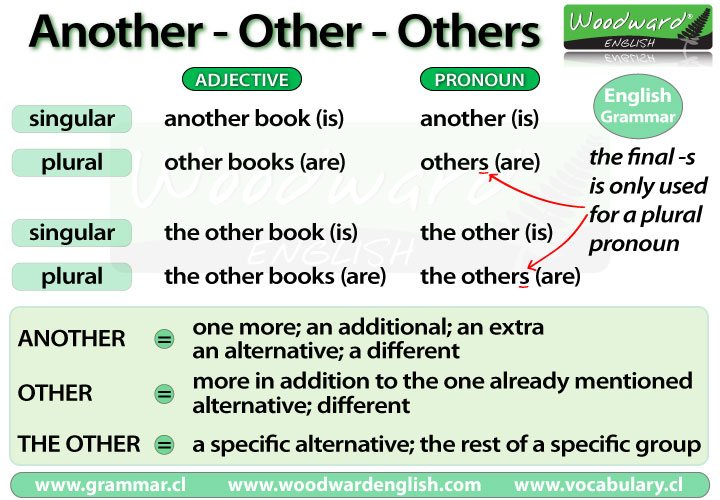
Read this interesting webpage where you can see clearly when to use 'other' or 'another'. I'm sure it'd be useful to refresh your grammar about this particular point.


Quick Summary: What is the difference between another and other?

A simple rule to help you remember the difference between another and other is:
another + singular noun
other + plural noun
others (a pronoun to replace other + plural noun)
  • I need another cup. (cup is singular so we use another)
  • I need other cups. (cup is plural so we use other)
  • I need others. (refers to other cups)

The difference between Another, Other and Others in English


When to use ANOTHER

Another means:
  • one more, an additional, an extra
  • a different one; an alternative one
Another is a determiner (and a qualifier) that goes before a singular countable noun or a pronoun.

Another + Singular Countable noun

Another can be followed by a singular countable noun.
  • He has bought another motorbike.
  • Would you like another cup of coffee?
  • Don’t worry about the rain. We can go another day.
  • I think you should paint it another color.
  • We are having another baby.

Another + One

Another can be placed before “one” when the meaning is clear from the text before it.
  • I have already eaten two sandwiches though now I want another one. (= an additional sandwich)
  • A: You can borrow more of these books if you like. B: Ok, I’ll take another one. (= another book, one more book)

Another as a pronoun

Sometimes another is used as a pronoun.
  • That piece of cake was tasty. I think I’ll have another. (another = one more piece of cake)
  • I don’t like this room. Let’s ask for another. (another = another room)
Note: you can also say: “I think I’ll have another one.” and “Let’s ask for another one.”

Another + number + plural noun

Another can be used before a plural noun when there is a number before that noun or before phrases such as a couple ofa few etc.
  • In another 20 years my laptop is going to be obsolete.
  • I like this city so much that I’m going to spend another three days here.
  • We need another three teachers before classes begin.
  • He was given another couple of months to finish the sculpture.

When to use OTHER

Other is a determiner that goes before plural countable nouns, uncountable nouns or a pronoun.

Other + Plural Countable Noun

Other can be followed by a plural countable noun.
  • We have other styles if you are interested.
  • Have you got any other dresses, or are these the only ones?
  • Some days are sunny though other days can be very rainy.
  • I have invited some other people.
  • I can’t help you because I’m busy with other things.

Other + Ones

Other can be placed before the pronoun “ones” when the meaning is clear from the text before it.
  • We don’t need those books, we need other ones. (= different books)
  • A: You can borrow my books if you like. B: Thanks, but I need other ones. (= other books)
Note: you can say other one when it refers to wanting the alternative.
  • I don't want this one, I want the other one.

Others as a pronoun

Others replaces “other ones” or "other + plural noun".
Only others can be used as a pronoun and not other.
  • I don’t like these postcards. Let’s ask for others. (others = other postcards)
  • Some of the presidents arrived on Monday. Others arrived the following day.

Others - the others

Often “(the) others” refers to “(the) other people”.
  • He has no interest in helping others. (= in helping other people)
  • What are the others doing tonight?

What is the difference between other and others?

Other is followed by a noun or a pronoun
Others is a pronoun and is NOT followed by a noun.

  • These shoes are too small. Do you have any other shoes?
  • These shoes are too small. Do you have any others? (no noun after others)

Click here to see the whole page and do more practice: other or another


jueves, 19 de abril de 2018

miércoles, 7 de marzo de 2018

Key to grammar Unit 4 and modal verbs

You can see here the answers to the first 3 exercises.


And you can also see the information about the modal verbs we saw in class in this link:
Functions and modal verbs


domingo, 26 de noviembre de 2017

Future tenses

Better late than never!
Click here to see the summary of the different ways to express the future in Englisg:

Future_tenses

Resultado de imagen de future tenses

viernes, 10 de noviembre de 2017

Practise the ellipsis

Can you put this dialogue in the right order? I'm sure you can. Give it a try!


Very funny!
Biscuit?
You joking?
Please, two.
I shouldn’t. Diet starts tomorrow!
Love one.
Sugar?
Fancy a cup of tea?
No. Not at all. It always starts tomorrow!


 Come to class with the dialogue organised.


miércoles, 8 de noviembre de 2017

Showing reactions

I attach here the stucture we saw in the last class. I hope you assimilate the structure and are then able to produce more sentences to make sure you can use it properly.

Showing_reactions

"To her utter delight she  realised that all her students had completely understood her explanations."

viernes, 26 de mayo de 2017

Reported Speech

I have posted 3 documents:

- the basic rules you should already know about the reported speech with some little practice and the key
- extra exercises of R. S and some passive with the key too.
- the key to the revision photocopy  I gave you in class.

Reported Speech- basic rules

R.P. & passiv exercises + key

R.S. review + key

To be continued ...

martes, 9 de mayo de 2017

Passive voice

Here you have a table with the transformations from active to passive, or the other way around, plus some examples.

Passive voice table
Resultado de imagen de passive voice

domingo, 22 de enero de 2017

Some common phrasal verbs

Here you have a list of some of the most common phrasal verbs. Try to learn them all. Or at least, most of them.


Thank you, Irene!

miércoles, 18 de enero de 2017

Multi-word verbs

What's the difference between phrasal verbs and prepositional verbs?

What do Phrasal and Prepositional Verbs have in common and what are the differences?

Two-word verbs can be Phrasal Verbs or Prepositional Verb.
Phrasal Verbs often have a very different (idiomatic) meaning.
  • verb: look
  • adverb: in
  • Phrasal Verb: look in

1. What is the difference between a preposition and an adverb and why this distinction is important.

An object can go before or after an adverb – but it can only go after a preposition. So:
  • Phrasal Verbs can be separated
  • Prepositional Verbs must not be separated.

1.1. Phrasal Verbs

  • correct: verb + object + adverb → I switch the computer on.
  • correct: verb adverb + object → I switched on the computer.

1.2. Prepositional Verbs

  • correct: verb + preposition + object → The cat jumped on the computer.
  • incorrect: verb + object + preposition → The cat jumped the computer on.
Note: Some adverbs can be also used as a preposition. You should use a good dictionary to find out whether the word is an adverb or a preposition.


Find out more by clicking in this link about why not every multi-word verb is a phrasal verb: multi-word verbs

Resultado de imagen de pictionary of common phrasal verbs

Miguel, I hope you see the differences!


jueves, 15 de diciembre de 2016

Future time clauses

And you can check here some information about the future time clases and conditionals.


Future time clauses

UNLESS
    IF
      AS SOON AS
         WHEN
            PROVIDED
               AS LONG AS
                   IN CASE

jueves, 6 de marzo de 2014

INFINITIVE OR GERUND?

I know it's quite hard to know when the verbs are followed by infinitive (with or without to) or gerund in English.

You can see here a table which has a list of verbs for all the cases, including when they are followed by an object and when it's posible to use a 'THAT clause'. You can also find verbs that change their meaning depending on the verb form that follows.

I hope you find it useful.

Infinitive or gerund


martes, 30 de abril de 2013

Place and movement

This document contains the key to the 'place and movement exercises' as well as the explanations for the use of all the possibilities given.

Place and movement


jueves, 25 de abril de 2013

I wish ...

Here I copy a little reminder. I wish I had done it before ...

TO EXPRESS WISHES IN THE PRESENT

  • If Susan wasn’t going out with Peter, I’d ask her for a date.
  • I wish Susan wasn’t going out with Peter.

  • If I had enough money, I’d buy a Mercedes.
  • I wish I had enough money to/ I wish I could buy a Mercedes.

  • If my parents didn’t live so far away, I’d see them more often.
  • I wish my parents didn’t live so far away.

  • If I didn’t have my final exams in a week, I’d have more free time.
  • I wish I didn’t have my final exams next week / I wish I had more free time.

  • If I could, I’d stop smoking.
  • I wish I could stop smoking.


TO EXPRESS WISHES IN THE PAST (examples)

  • I wish I hadn’t made a lot of mistakes in the exam.
  • If only I had studied more for the exam.

  • I wish I hadn’t spent so much money.
  • If only I hadn’t spent so much money.

  • I wish I hadn’t played hooky so much last term.
  • If only I had attended my classes last term.

  • I wish I had studied in a high school.
  • If only I hadn’t been sent to a boarding school.

  • I wish my team hadn’t played awfully last Sunday.
  • If only my team had played better last Sunday.

martes, 16 de abril de 2013

CONDITIONAL SENTENCES


Conditional sentences (OUP)

Type 1 conditional sentences

They are used to talk about a possible present or future situation and its result.

You can use any present tense in the if clause and any form of the future in the other clause.
 
Examples:

They won’t get a table unless theyve already booked.

Can I borrow your dictionary a moment if youre not using it?

If it stops raining, Im going to walk into town.

 
Type 2 conditional sentences
 
They are used to talk about hypothetical or improbable situations in the present or future.

You can use the past tense (simple or continuous) in the if clause and would + infinitive (or could/might) in the other clause.

 
Examples:

How would you know if he wasn’t telling the truth?

If we had a bit more time here, we could go on an all-day river trip.

Type 3 conditional sentences are used to talk about a hypothetical situation in the past.


Type 3 conditional sentences
 
Type 3 conditional sentences are used to talk about a hypothetical situation in the past.

You can use the past perfect (simple or continuous) in the if clause and would have + past participle (or could/might have) in the other clause.

 
Examples:

I would have picked you up if I had known what time your flight arrived.

If I’d been looking where I was going, I would’ve seen the hole in the road.
 

Mixed conditionals

If we want to refer to the present and the past in the same sentence, we can mix tenses from two different types of conditional, e.g.

Examples:

I wouldn’t be in this mess (type 2) if I had listened to your advice (type 3).

Jane would have left Mike by now (type 3) if she didn’t still love him (type 2).

 
alternatives to if in conditional sentences

We often use as long as/so long as, provided/providing (that), and on condition (that) instead of if to emphasize what must happen or be done for something else to happen.

 Examples:

I’ll tell you what happened as long as/so long as you promise not to tell anyone else.

Provided/Providing (that) the bank lends us all the money we need, we’re going to buy that flat we liked.

They agreed to lend us the car on condition (that) we returned it by the weekend.

That is often omitted in spoken English. On condition that is slightly more formal than the other expressions.

We can use whether + subject + verb + or not instead of if to emphasize something is true in either of two cases.

I’m going to sell the car whether you agree with me or not.

The word order can also be:

I’m going to sell the car whether or not you agree with me.

 We can use even if instead of if for extra emphasis.

Even if I get the job, I’m going to carry on living with my parents for a while.

We can use supposing when we ask someone to imagine that something is true or will happen. It is usually used at the beginning of a sentence.

Supposing you lost your job, what would you do?

In type 3 conditionals in formal or literary English we can invert had and the subject and leave out if. Had I known = If I had known…

Had I known that you were coming, I would have bought a bottle of wine.