lunes, 10 de diciembre de 2018

Key to review 1

Make the corrections before going to class on Tuesday, please.


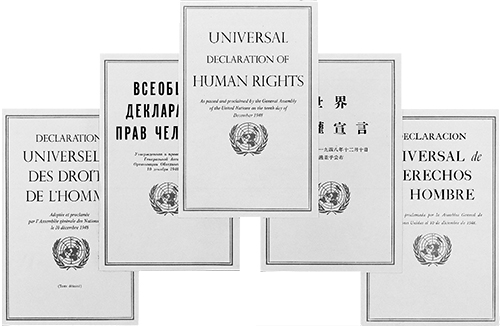
Universal Declaration of Human Rights - 70 years

What Are Human Rights?

Human rights are rights inherent to all human beings, regardless of race, sex, nationality, ethnicity, language, religion, or any other status. Human rights include the right to life and liberty, freedom from slavery and torture, freedom of opinion and expression, the right to work and education, and many more.  Everyone is entitled to these rights, without discrimination.
Universal Declaration of Human Rights
The Universal Declaration of Human Rights (UDHR)is a milestone document in the history of human rights. 
Drafted by representatives with different legal and cultural backgrounds from all regions of the world, the Declaration was proclaimed by the United Nations General Assembly in Paris on 10 December 1948 by General Assembly resolution 217 A (III) as a common standard of achievements for all peoples and all nations. It sets out, for the first time, fundamental human rights to be universally protected. Since its adoption in 1948, the UDHR has been translated into more than 501 languages – the most translated document in the world - and has inspired the constitutions of many newly independent States and many new democracies. The UDHR, together with the International Covenant on Civil and Political Rights and its two Optional Protocols (on the complaints procedure and on the death penalty) and the International Covenant on Economic, Social and Cultural Rights and its Optional Protocol, form the so-called International Bill of Human Rights.


And here you can read the first 10 articles:

Article 1.
 

All human beings are born free and equal in dignity and rights. They are endowed with reason and conscience and should act towards one another in a spirit of brotherhood.

Article 2.
 

Everyone is entitled to all the rights and freedoms set forth in this Declaration, without distinction of any kind, such as race, colour, sex, language, religion, political or other opinion, national or social origin, property, birth or other status. Furthermore, no distinction shall be made on the basis of the political, jurisdictional or international status of the country or territory to which a person belongs, whether it be independent, trust, non-self-governing or under any other limitation of sovereignty.

Article 3.
 

Everyone has the right to life, liberty and security of person.

Article 4.
 

No one shall be held in slavery or servitude; slavery and the slave trade shall be prohibited in all their forms.

Article 5.
 

No one shall be subjected to torture or to cruel, inhuman or degrading treatment or punishment.

Article 6.
 

Everyone has the right to recognition everywhere as a person before the law.

Article 7.
 

All are equal before the law and are entitled without any discrimination to equal protection of the law. All are entitled to equal protection against any discrimination in violation of this Declaration and against any incitement to such discrimination.

Article 8.
 

Everyone has the right to an effective remedy by the competent national tribunals for acts violating the fundamental rights granted him by the constitution or by law.

Article 9.
 

No one shall be subjected to arbitrary arrest, detention or exile.

Article 10.
 

Everyone is entitled in full equality to a fair and public hearing by an independent and impartial tribunal, in the determination of his rights and obligations and of any criminal charge against him.

viernes, 7 de diciembre de 2018

Teacher Man: questions for chapter 12


CHAPTER 12
Answer the following questions:
-          In Stuyvesant something changes in his teaching life for the first time. What is it? How does it affect him?
-          His professional life improves, but he can’t be completely happy. What happened in his private life?

jueves, 6 de diciembre de 2018

Luxembourg to become first country to make all public transport free

Government seeks to prioritise environment and end some of world’s worst traffic congestion

Luxembourg City, the capital of the small Grand Duchy, suffers from some of the worst traffic congestion in the world.
Fares on trains, trams and buses will be lifted next summer under the plans of the re-elected coalition government led by Xavier Bettel, who was sworn in for a second term as prime minister on Wednesday.
Bettel, whose Democratic party will form a government with the leftwing Socialist Workers’ party and the Greens, had vowed to prioritise the environment during the recent election campaign.
On top of the transport pledge, the new government is also considering legalising cannabis, and introducing two new public holidays.
Luxembourg City, the capital of the small Grand Duchy, suffers from some of the worst traffic congestion in the world.
It is home to about 110,000 people, but a further 400,000 commute into the city to work. A study suggested that drivers in the capital spent an average of 33 hours in traffic jams in 2016.
While the country as a whole has 600,000 inhabitants, nearly 200,000 people living in France, Belgium and Germany cross the border every day to work in Luxembourg.
Luxembourg has increasingly shown a progressive attitude to transport. This summer, the government brought in free transport for every child and young person under the age of 20. Secondary school students can use free shuttles between their institution and their home. Commuters need only pay €2 (£1.78) for up to two hours of travel, which in a country of just 999 sq miles (2,590 sq km) covers almost all journeys.
Now, from the start of 2020 all tickets will be abolished, saving on the collection of fares and the policing of ticket purchases.
The policy is yet to be fully thought through, however. A decision has yet to be taken on what to do about first- and second-class compartments on trains.
Bettel only just scraped back into government in the recent election. Opinion polls before October’s poll had indicated that the Christian Social People’s party (CSV) – led for 19 years by the European commission president, Jean-Claude Juncker – would end Bettel’s five years as prime minister.
The CSV, however, lost seats, while the Greens gained three seats. The result gave the coalition 31 seats in the 60-seat chamber.
The policy of the new government that has caused the most debate, however, has been that of legalising the purchase, possession and consumption of cannabis for recreational use.

lunes, 3 de diciembre de 2018

Climate change: Where we are in seven charts and what you can do to help

Read this interesting article about climate change.

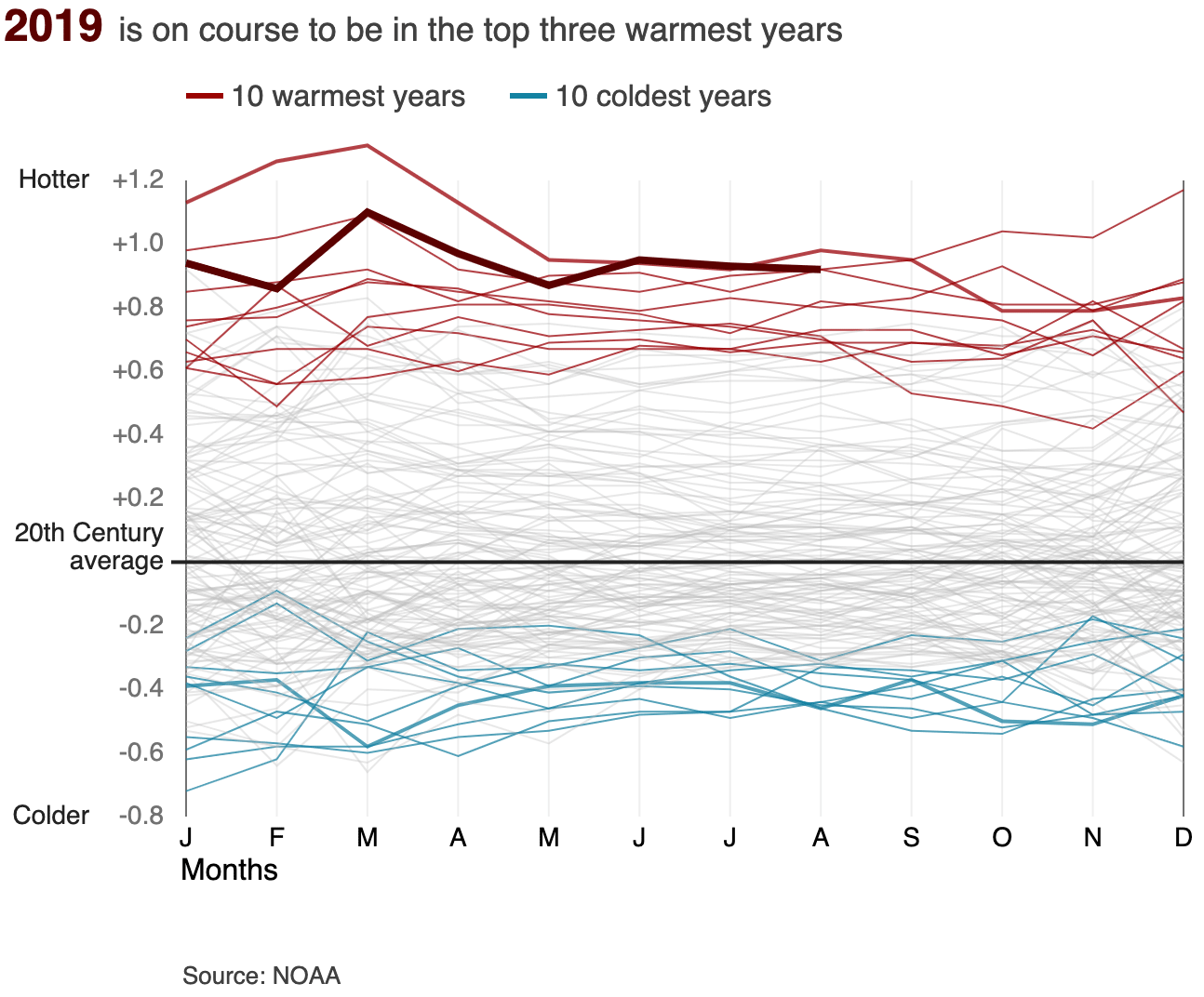
1. The world has been getting hotter


2. The year 2018 set all sorts of records

This year saw record high temperatures in many places across the world amid an unusually prolonged period of hot weather.
Large parts of the northern hemisphere saw a succession of heatwaves take hold in Europe, Asia, North America and northern Africa - a result of strong high pressure systems that created a "heat dome".
Over the period shown on the map below (May to July 2018), the yellow dots show where a heat record was broken on a given date, pink indicates places that were the hottest they had ever been in the month shown, and dark red represents a place that was the hottest since records began.

Read here the whole BBC-news article:


sábado, 1 de diciembre de 2018

Teacher Man, part 2

You can read here the questions for chapters 9 - 11. You have to answer them before our class next Tuesday when we'll discuss them. Enjoy it!


TEACHER MAN  -  Part 2

CHAPTER 9
1.     Explain why he left McKee Vocational and Technical High School and summarize his experience as a university adjunct lecturer.
2.      Why, in your opinion, didn’t he succeed when the told his university students “You have a right to think for yourselves”?
3.      Why did he give up his college career?
4.      What do we know about his family life so far? What is going on at home?
5.      What did he use the parts of a ballpen to explain?
6.      What are the problems underlying behind Hector’s incident?

CHAPTER 10
7.      What is a melting-pot school?  (Seward Park High School)
8.      What are the main problems of the students who attend this kind of schools?
9.      How did McCourt face the problem?


CHAPTER 11
10.  What challenges McCourt in his classes?
11.  Who is Andrew? What’s the connection of this kid with the teacher’s past?
12.  Why did Frank go to the psychologist? Was it positive for him?
13.  In your opinion, what does he think of psychologists after his experience?
14.  Why didn’t Ben Boom Boom react when McCourt made him fall in the classroom?
15.  How many times did he go to Dublin? How different was each occasion from the previous one?
16.  Why was he fired from the last school?