lunes, 3 de diciembre de 2018

Climate change: Where we are in seven charts and what you can do to help

Read this interesting article about climate change.

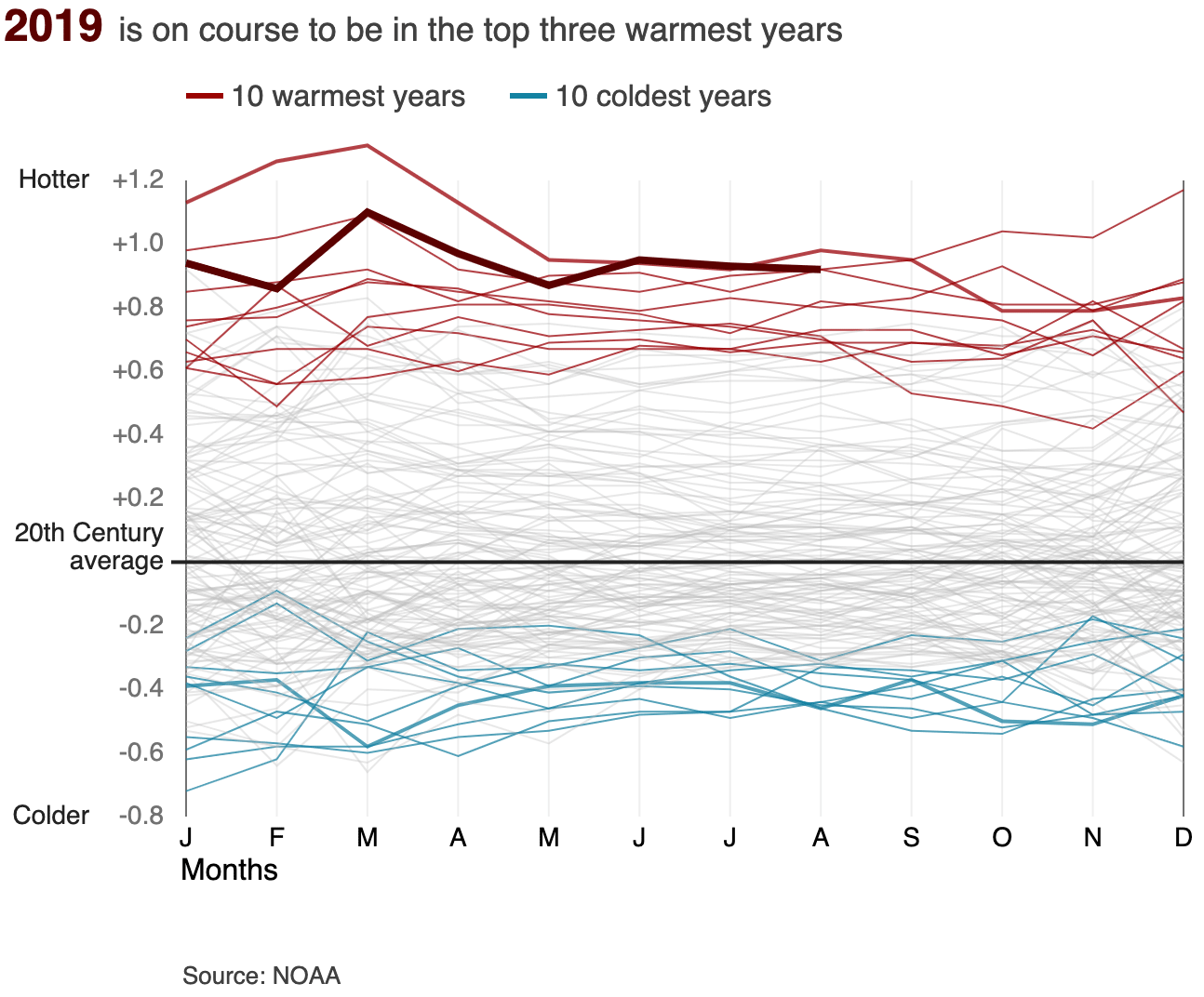
1. The world has been getting hotter


2. The year 2018 set all sorts of records

This year saw record high temperatures in many places across the world amid an unusually prolonged period of hot weather.
Large parts of the northern hemisphere saw a succession of heatwaves take hold in Europe, Asia, North America and northern Africa - a result of strong high pressure systems that created a "heat dome".
Over the period shown on the map below (May to July 2018), the yellow dots show where a heat record was broken on a given date, pink indicates places that were the hottest they had ever been in the month shown, and dark red represents a place that was the hottest since records began.

Read here the whole BBC-news article:


sábado, 1 de diciembre de 2018

Teacher Man, part 2

You can read here the questions for chapters 9 - 11. You have to answer them before our class next Tuesday when we'll discuss them. Enjoy it!


TEACHER MAN  -  Part 2

CHAPTER 9
1.     Explain why he left McKee Vocational and Technical High School and summarize his experience as a university adjunct lecturer.
2.      Why, in your opinion, didn’t he succeed when the told his university students “You have a right to think for yourselves”?
3.      Why did he give up his college career?
4.      What do we know about his family life so far? What is going on at home?
5.      What did he use the parts of a ballpen to explain?
6.      What are the problems underlying behind Hector’s incident?

CHAPTER 10
7.      What is a melting-pot school?  (Seward Park High School)
8.      What are the main problems of the students who attend this kind of schools?
9.      How did McCourt face the problem?


CHAPTER 11
10.  What challenges McCourt in his classes?
11.  Who is Andrew? What’s the connection of this kid with the teacher’s past?
12.  Why did Frank go to the psychologist? Was it positive for him?
13.  In your opinion, what does he think of psychologists after his experience?
14.  Why didn’t Ben Boom Boom react when McCourt made him fall in the classroom?
15.  How many times did he go to Dublin? How different was each occasion from the previous one?
16.  Why was he fired from the last school?

jueves, 29 de noviembre de 2018

WOULD - different uses and key to exercises


                  WOULD

1. To express unlikely or unreal situations:
Ex. We wouldn’t be here if we had taken the right train.

2. To express a past hypothesis or regret:
Ex. I wouldn’t have failed if I had worked hard.

3. To express habitual past with active verbs:
Ex. As a child, I’d walk to school every day.

4. To express the future in the past:
Ex. She met the man she would one day marry.

5. To express a refusal:
Ex. The car wouldn’t start.

6. To give advice:
Ex. If I were you, I’d stop smoking now.

7. To introduce cautious opinions:
Ex. I’d say / I’d imagine he is a good colleague.

8. To make polite requests, and express wants and preferences:
Ex. Would you mind opening the window?
I’d like to leave now. I’d prefer to go by train.

9. Past of will (often in reported speech):
Ex. She said she would come.

Key to exercises:


Togolese innovators turn the world's junk into robots

Togo imports an estimated 500,000 tonnes of e-waste a year, some of it can be a health hazard, but it also inspires local innovators and provides jobs.
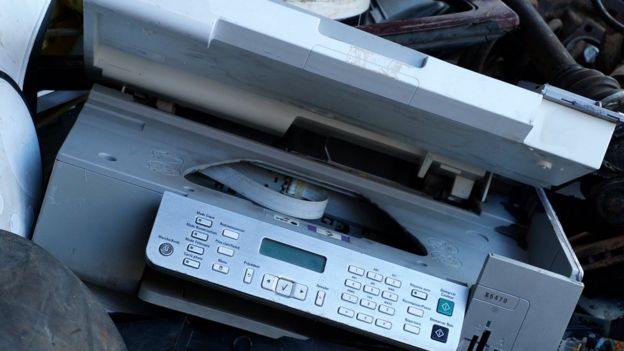
A printer at a landfill
It looks like a spider and it moves like one, but this robot creature cannot just be dismissed as a toy.
It is also a symbol of the digital revolution brewing in one of West Africa's smallest countries.
"I made this from a [discarded] 3D printer," Ousia Foli-Bebe says, pointing as his robotic arachnid.
"The plastic retrieved from the printer became the arms and legs. And I made a 3D printer as well from e-waste. I actually learned how to make the printer from the internet," he adds.
Mr Foli-Bebe takes the robot spider into schools hoping to interest the students in science and recycling.
"My hope is to make a science kit so that they can begin to make their own things and solve the problems of this community," the inventor says.
His Ecotec lab is situated in Amadanhome on the outskirts of Togo's capital, Lomé.
It is a modest space, with a blackboard dominating one wall and a 3D printer next to the opposite wall.
The 29-year-old is one of a growing number of young entrepreneurs who see all the e-waste imported by Togo as an opportunity.
Local environmental body E-Waste Centre estimates that 500,000 tonnes come into the country every year.
Outside his lab is a motley collection of old televisions and other used electronic goods spread over a tennis-court-sized dumpsite.
Conveniently, Mr Foli-Bebe shares the site with an e-waste recycler, giving easy access to parts for his inventions.
He admits he has learned a lot about recycling from others such as Gnikou Afate, who is credited with having made the first 3D printer in Togo.
So impressive was Mr Afate's homemade printer that it took first place at the Barcelona Fabrication Technology conference in 2015.
The soft-spoken 39-year-old innovator, who previously used to collaborate with another technology hub called Woelab, one of the best in town, recently started his own lab and operates out of a small workspace next to his house.

The new 'goldmine'

"At first, electronic waste was a plague - that's how we used to describe it," Mr Afate says.
"Our streets were littered with old computer bodies rotting away. But today that problem has turned into an opportunity. E-waste could be described as a goldmine."
Only 41 countries in the world, , most of them European, collect statistics on e-waste, according to The Global E-waste Monitor report.
In 2016 people around the world generated about 44 million tonnes of electronic waste, the report said.
Old mobile phones, laptops, TVs and generators jammed inside vans and lorries form part of what comes through Lomé's port.
The vehicles are opened up at a market next door to the port and the buyers gather round.
The rising demand for technology has created a market for people who want to buy second-hand electronics at bargain prices.
But it is not just demand for these products that is encouraging their arrival. It is also the inadequate recycling available in richer countries.
Organisations such as the Basel Action Network are raising concerns that Western countries are simply not handling their own electronic waste effectively, leaving it destined to end up on cargo ships bound for West Africa, among other places.
"The world does not know what to do with the e-waste that it is producing. Africa offers the best environment for dumping," says activist Sena Alouka from Youth for the Environment Togo.
"We have a weak regulatory framework, weak institutions and corruption also aids in the movement of e-waste. We need to emulate Thailand who threatened to use her military to ban the import of electronic waste."
While it is not against international law to export used goods to other countries, the problem comes about if these goods no longer work as outlined by treaties such as the Basel and Bamako conventions.
The Bamako convention, which came into force in 1998, commits African nations to banning the importation of hazardous waste, including radioactive material.
It also encourages countries on the continent to adopt legislation to control the importation of near-end-of-life or unwanted equipment by designating such equipment as hazardous waste.
"Think of a set of televisions - they have cadmium, lead and beryllium. All those are toxic and very dangerous to humans and to the environment," Mr Alouka says.
"They can find their way to aquifers, spill into the ocean. We eat the fish. They contain mercury and much more. [It is] very dangerous for our health. Especially to our children."
It is, however, a challenge to regulate electronic waste management because many people earn a living from it.
"If you look at the types of waste which arrives here, a lot of it is highly dangerous and toxic so we should really evaluate the economic impact that it could have on our environment," Hervé Tchamsi from the E-Waste Centre, a recycling business, says.
His team tries to minimise their exposure to the hazardous materials in the e-waste and he hopes this higher standard will one day be the norm in Togo.

Sent back to Europe

But for now, what they cannot repurpose, they export back to Europe, where it originally came from. An irony that is not lost on Mr Tchamsi.
"Here are the TVs that contain the toxic materials. We pay to send these back to Belgium for recycling - because we do not have the capacity here to recycle the e-waste in a safe way," he explains.
In a country with limited job opportunities for its young people there is huge potential for this industry.
Innovators and entrepreneurs alike are trying to come up with solutions that harness that potential and mitigate the dangers.
By Waihiga Mwaura
BBC NEWS
You can now watch some interesting videos and pictures published by BBC News clicking here:


viernes, 23 de noviembre de 2018

Key Differences Between Customer and Client

The important differences between customer and client are discussed as under:

  1. A person who purchases goods and services, from the company is known as the Customer. Client refers to someone who seeks professional services from the company.
  2. There exist an agency agreement between the client and the service provider. Conversely, there is no such agreement between the customer and the business entity.
  3. The customer engages in a transaction with the company whereas the company and clients are in a fiduciary relationship with each other.
  4. A company focuses on selling the product and services to the customer. On the other hand, the company focuses on serving the client.
  5. The company offers goods and services to its customers. Talking about clients, who seek for professional services like advisory, legal, consultancy and may more.
  6. The degree of personal attention required in case of the customer is less as compared to the client.
  7. A relationship between customer and business exist for a short term only. However, a customer can have repeated transactions but only for a limited time. In the case of a client, the business engages in a long-term project with the client.

Conclusion

The main difference between the words customers and clients is in the terms selling and serving. There are many instances that can make you think that these two entities are different. As for example, a company has the client of United States, to whom the company serves its professional services and at the same time the company offers and sells its products to the customers of different parts of the world.
Both are very important part of the organisation as they help the organisation to grow and flourish in the long term. The business should make products as per the demands of the customer and provide services according to the client’s requirement. This will prove helpful for the company to retain old and existing or new customers and clients.
You have the link here, in case you'd like to read more:


lunes, 19 de noviembre de 2018

Speaking about Nigeria ...

One culture, two languages.

Watch this conversation between a Nigerian mother (Habiba) and her British daughter (Lola) about language.

BBC_stories

Now answer these questions:

1. Why did they stop speaking to their daughter in Yoruba at home?
2. What is the "Windrush thing" Lola mentions? Maybe you'll have to do some research!
3. How do Nigerians get their names, according to the mother?
4. When does the  mother become so emotional and why?
5. Was it hard for Lola not to speak Nigerian fluently when she met other Nigerians?