Mostrando entradas con la etiqueta BBC. Mostrar todas las entradas

domingo, 4 de noviembre de 2018

Talking about witches ...

Canada's last witch trials: Women accused of fake witchcraft

A law against pretending to practise witchcraft will soon be repealed in Canada. But that hasn't stopped local police from prosecuting those who use the "dark arts" to bilk people for thousands of dollars.
Two Canadian women have been charged with pretending to practise witchcraft, breaking a little-known law in Canada's criminal code that could soon be out the door.
The first charge was levied against Dorie "Madeena" Stevenson, a fortune teller from Milton, Ontario on 18 October after a months-long investigation.
She is accused of defrauding a client of C$60,000 ($45,700; £35,700) in cash and property.
A week later, Toronto psychic Samantha Stevenson was also arrested in a similar but unrelated investigation.
Police allege she convinced a man the only way to get rid of "evil spirits" in his home would be to sell it, and transfer the proceeds into her account.
The accused often advertise themselves as a psychic or religious healer, and demand large sums of money to help remove curses or evil spirits from clients, police say.
"What we typically see is a tendency for perpetrators to take advantage of persons when they are in their most vulnerable state," wrote Det Sgt Dave Costantini of Halton Regional Police, in a press release.
"Victims are manipulated into believing something bad will happen to them unless they remit cash. We even see incidents where victims are required to make purchases and remit these purchases in order to be cleansed.
"When victims cannot be squeezed any longer, the perpetrators rely on the victim's embarrassment in not contacting police."
The charges could lead to Canada's last witch trials, as the section of the law banning pretending to practise witchcraft will soon be repealed.
In June 2017, the federal government proposed a bill repealing dozens of outdated sections of the criminal code, including the law against pretending to be a witch.
"I suspect police had just forgotten [the laws against witchcraft] existed, and it was the publicity over the fact that they were being removed that made police even remember that they were there," said Dalhousie University law professor Stephen Coughlan.

Is witchcraft illegal in Canada?

It is not illegal to practise witchcraft in Canada - either as part of a religion like Wicca or as an occult practice.
However, according to Section 365 of Canada's Criminal Code, it is illegal to "fraudulently pretend to exercise or to use any kind of witchcraft, sorcery, enchantment or conjuration".
The law has generally been interpreted as a provision against using the occult to perpetuate fraud, say by someone promising to cure a disease with magic.
The conviction can lead to a C$2,000 fine and up to six months in jail.
The law has rarely been applied in the 21st Century, although it is not unheard of:
  • In 2017, astrologist and psychic Murali Muthyalu was charged with witchcraft after a client allegedly paid $100,000 to have a curse removed. The witchcraft charge was dropped and he pleaded guilty to fraud
  • In 2012, a man who billed himself as a "healer" was charged with witchcraft after clients paid him tens of thousands of dollars to remove curses. All charges were dropped after he agreed to pay restitution
  • In 2009, Vishwantee Persaud was charged with witchcraft in addition to multiple fraud charges. The charge of witchcraft was eventually dropped. Prosecutors withdrew the witchcraft charge after she pleaded guilty to fraud
The law has been criticised for targeting women and cultural groups where beliefs in magic are more widespread.
"The provision that differentiates this type of fraud from others is mired in historic oppression of women and religious minorities, and is not necessary to prosecute fraud," wrote Natasha Bakht and Jordan Palmer in a working paper published in the journal Windsor Review of Legal and Social Issues.

Canada's last witch trial?

All this is about to change.
A proposed bill to repeal antiquated or redundant criminal offences passed its third reading in the Senate last week, and it is expected to come into force as soon as it receives royal assent.
The bill would repeal the law against pretending to be a witch, as well as other old-fashioned prohibitions such as laws against duelling and blasphemous libel.
Coughlin, the legal expert, told the BBC the bill is necessary to help bring the criminal code, parts of which date back to 1892, into the modern era.
"A lot of them are just out of step with the time, out of step with the facts or really, are duplicative of other offences," says the Dalhousie University professor.
"In the case of the witchcraft [law], realistically any behaviour that would fall within that provision... would also be captured by other provisions in the criminal code, like fraud."
Until the law comes into force, however, police have every right to charge being with pretending to practice witchcraft.
"It's not uncommon for police to lay every charge they can think of, simply because it gives them a bargaining chip," he says.
To read more, click here: Canada's witches

miércoles, 1 de agosto de 2018

Are first impressions really accurate?

Fictional stories are replete with villains and heroes with an almost magical ability to discern other people’s characters – think Hannibal Lecter or Sherlock Holmes. In real life, too, many people (including certain world leaders) seem to think they have this skill. Question-and-answer sites like Quora are filled with posts like: “I can read people’s personalities and emotions like a book. Is this normal?
But do any of us really have an exceptional skill for judging other people’s personalities?
Psychologists call such people – or the idea of them – “good judges”. And for more than a century, they have been trying to answer the question of whether these good judges really exist.

Until recently, the conclusion was that the concept is essentially a myth. Most of us are pretty gifted at determining each other’s characters, the evidence suggested. But there is barely any variation in the skill from one person to another.
However, an intriguing new paper has forced a rethink by providing new, compelling evidence that good judges do exist after all. But their skill only becomes apparent when they are reading expressive people who reveal honest cues to their characters. “Simply put,” write Katherine Rogers at the University of Tennessee at Chattanooga and Jeremy Biesanz at the University of British Columbia, “reports highlighting the demise or irrelevance of the good judge may have been greatly exaggerated.”
One of the first attempts to identify good judges was published by US psychologist Henry F Adams in 1927. He asked eight teams of 10 young women, who knew each other well, to rate each other’s personalities. He also requested that they rate their own. He averaged the ratings each volunteer received from the others to obtain their ‘true’ personality – then he crunched the numbers to see if some individuals had an unusual ability to perceive character accurately, other people’s or their own.
This is where Rogers and Biesanz come in. They think there are two key reasons for the flaky evidence for good judges. First, researchers have been inconsistent in what they mean by a good judge. Sometimes they’ve meant the ability to read personality, but other times they’ve looked at something like reading emotions or spotting lies, which is significant because there’s evidence these are distinct skills. Second, researchers have failed to take into account the part played by the person whose personality is being read.
The pair’s revelation is that there are not only good judges, but also “good targets” – people who make relevant and useful cues to their personality available. The abilities of the good judge will only manifest when reading good targets. “Much the same way a new calculus book on Amazon that does not make sample content available online will not be understood and evaluated any better by a calculus teacher than a student struggling with arithmetic, a calculus book with chapters provided online will be understood exponentially better by a calculus teacher than the same arithmetic student”, they write.
To test their argument, Rogers and Biesanz recruited thousands of college students to either chat to an unfamiliar person for three minutes or watch a video of someone they didn’t know for three minutes, and then to rate that person’s personality. The students’ personality estimates were then compared to the target persons' “true personality” based on their own self-description and ratings given by a friend or relative who knew them well.
Crucially, as well as analysing the data to see if some participants were exceptionally accurate at judging other people’s personalities, Rogers and Biesanz also categorised those having their personality scrutinised as either good or bad targets (based on how accurately, on average, the participants were able to judge them).
The data showed that there were good judges – a minority of participants who were significantly better than average at accurately judging the personalities of others. But it also showed that this was only true in the context of judging good targets.
“We found consistent, clear and strong evidence that the good judge does exist”, Rogers and Biesanz concluded. But their key finding that this skill only applies when judging certain open individuals means that “the ability to somewhat magically discern the personality of others, as displayed in characters like Sherlock Holmes or The Mentalist, is not supported here.”
By comparing good judges’ performance in live interactions and videos, the researchers also were able to consider whether the good judges’ skill lies purely in detecting revealing cues or in influencing the target to reveal those cues. Here the results were equivocal – mostly, the skill seems to be in reading cues, although performance was modestly higher in live interactions, suggesting also some part played by the ability to extract those cues. At least for short interactions, then, the good judges’ “primary tool is the ability to appropriately detect and utilise information provided by the good target”, they said.
What’s exciting about these new findings is that we now know that good judges probably do exist and how to better identify them (they need to be tested with “good targets”). This means that more investigations can be opened up into how they do it, what kind of people they are – and whether their skills can be taught.
BBC News, by Christian Jarrett, 30 July 2018


martes, 5 de diciembre de 2017

My shock at discovering I was a donor child

Things can get complicated when you find out where you really come from. Some people can accept it without any problem. For others, it is really  hard to cope with it.

Read this interesting article about some real cases.


When parents tell a child that he or she was conceived from a donated egg, or donated sperm, it can come as quite a shock.
After Elaine Chong wrote about donating her eggs to help other couples have a child, two readers got in touch to explain how the revelation that they were donor children affected them - one said it split his family, the other said it drew hers even closer together.

'My entire existence is a lie'

I found out I was donor-conceived when I was 22. The conversation was not planned. When my younger sister discovered she was pregnant she asked my parents if there were any hereditary family conditions that she needed to be mindful about. Then my parents told her that they couldn't answer her question that she had been born as a result of gamete donation.
My social father (this is what we call the parents who raise us) then told me that was also the case for me. He said they had gone to a doctor at Harley Street who had helped them conceive both myself and my sister, who is three years younger. But that was all he was willing to talk about and neither he nor my social mother wanted to discuss the subject any more.
As I was conceived in the early 80s it's impossible to find records as to who the egg and sperm donors, my biological parents, are. It was rare for that information to be kept on file then.
I'd often wondered why I looked so different to the people that raised me. I'm tall, hairy, with dark eyes and features. My parents are shorter, pale with light eyes. I started wondering if maybe I could be of a different ethnicity. Suddenly my whole existence felt like a lie.
My relationship with my social parents deteriorated and I spent years moving around, doing a number of odd jobs. I also battled with gambling issues. I felt like a gypsy. I should add that my sister had a different reaction to me. She maintains a good relationship with our social parents, whereas mine has almost entirely broken down.
Even though I am now married, with a young child of my own, I am still against gamete donation. We shouldn't be playing around with science like this. If I had been adopted, it would be easier to trace the story of how I came to be and easier to find roots. As it stands it's unlikely that my egg or sperm donor parents knew each other, and I don't know the motivations of why they chose to donate.
I feel that donor conception is a trade in human beings and very few people consider the effects it has on a child.
John, 35, UK

'I also want to be an egg donor'

My sister and I have always been almost opposites - which was the main reason why I could tell something was different between us. She was slim, smart, and a rule-abider. I was more of a wild child with an athletic build. Throughout our childhood, it was always a joking topic, but it was never addressed until I was 11.
My dad and I were in the car and I had brought up again how my sister and I were so different. He said: "Yeah, we can talk about it when we get home." I was like, what? After all this time, now there's an explanation! In a way it was satisfying to know that my premonitions were correct.
At home, it was a full family conversation. My mom cried when she confirmed my suspicions that my sister and I weren't fully related.
She'd had a problem with her IUD implant in the 70s that affected her uterus and the transport of her own eggs. She had never told anyone in her family except for her mother because of the stigma against not being able to get pregnant.
My parents told me that my sister was an in-vitro fertilisation (IVF) baby, with my mom's egg and my dad's sperm, and that I was conceived from an egg donor with my dad's sperm.
It was very emotional. I can vividly remember that.
It's such a fragile state to be in, to have your own kid question where they're from. It was one of those things where my mom thought if I knew that I wasn't necessarily related to her, I would push her away - that's what she conveyed to me.
After, I remember sitting in my room and I felt like I had known it was true the whole time. I had grown up with these differences and my parents never loved me any less. I've never felt betrayed - I've just felt grateful for the chance to be given life.
My mom and I have gotten closer because of it. I think it is the bravest thing she has ever done. I began to see how it had shaped her as a mother too - every night she would tell my sister and me: "We did everything to have you, we're so grateful for you in our lives." Now I understand that they really did do everything.
As I got older, I became more intrigued by IVF. I thought it was very interesting to see how my parents had taken this very new technology and applied it to their lives.
I want to be an egg donor once I finish college because it would make me feel so proud.
I want to represent a successful story of in-vitro. My mom is very supportive of me becoming an egg donor. I think it would make her feel like she has continued the process of family completion in a way.
Donor conception is still seen as a very secretive process, but I think if it were to have more light brought to it, things might change. If I could help at all to de-stigmatise the idea, I would feel very proud.
Elizabeth, 21, US

When to tell the children

If children have been conceived from a donated egg or sperm it's good to tell them early, says Nina Barnsley, director of the Donor Conception Network. Ideally at the age of five, and no later than 10.
This allows them to get used to the idea as they grow, and averts the possibly traumatic experience of a sudden revelation later on. "It ends up being just an exciting story of how they came into the world," she says. "Parents should see it as an open door to continuing the conversation as the child wishes and ages."
If parents wait until their child is an adult, they may be asked why they hid the truth for so long. But late is better than never, Barnsley says, and better than a deathbed confession. "We've had children in their 30s with parents in their 70s when they have the conversation. It can go very well."

                                                                                                                  BBC stories


jueves, 31 de agosto de 2017

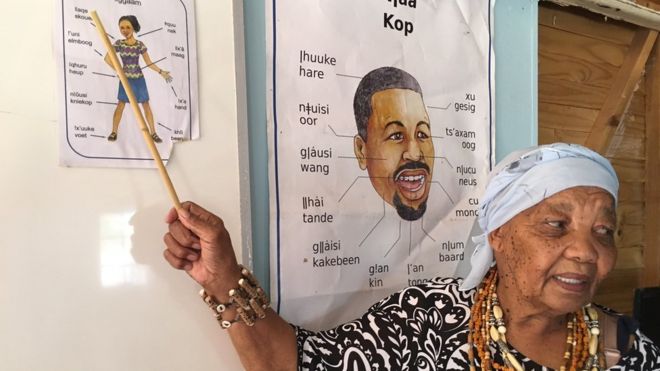
Trying to save South Africa's first language

Read this very interesting article about how a very few people are trying to save South Africa's first language. It'll make us think about the importance of our mother tongue, language and communication.

"We would get beaten up by the white man if we were caught speaking our language", says Katrina Esau.


Katrina Esau is working hard to save the language of her childhood from dying out.
At 84, Ms Esau is one of the last three fluent speakers of N|uu, one of the languages spoken by South Africa's San community, also known as Bushmen.
N|uu is considered the original language of southern Africa.
With no other fluent speakers in the world apart from this family, the language is recognised by the UN as "critically endangered".

Read the whole article clicking here: Trying to save South Africa's first language


Katrina Esau teaching a class in Upington, Northern Cape

martes, 25 de octubre de 2016

Women 'nearing equality with men - in alcohol consumption'

The analysis of 4 million people, born between 1891 and 2001, showed that men used to be far more likely to drink and have resulting health problems.
But the current generation have pretty much closed the gap, the BMJ Open report says.
The changing roles of men and women in society partly explain the move towards drinking parity.
The study showed that in people born in the early 1900s, men were:
  • More than twice as likely as women to drink alcohol at all (2.2 times)
  • Three times as likely to drink to problematic levels
  • And 3.6 times as likely to develop health problems from drinking, such as liver cirrhosis
But over the ensuing decades, the gap closed so that for those born at the end of the century men were only:
  • 1.1 times as likely as women to drink alcohol at all
  • A much lower 1.2 times as likely to drink to problematic levels
  • And 1.3 times as likely to develop health problems from drinking

(...)
"The increasing availability of alcohol also plays an important part, as does the way that alcohol marketing is often targeted specifically at women and particularly young women.
"Health professionals need to help the public - both men and women - to understand the health risks of alcohol consumption, and how to reduce those risks."


Read the whole article clicking here:
BBC News 

lunes, 2 de febrero de 2015

Chip and skin: The office that microchips its staff

29 January 2015 


A new office block in Sweden is offering workers the chance to have a microchip implanted under their skin to allow them to access to various services within the building.
A tiny gadget the size of a grain of rice is implanted in employees hands. It then allows them to open doors, or use the photocopier, without a traditional pass card.

Chief technology correspondent Rory Cellan-Jones went to try it out.

Click here to watch the video and see the complete article.