Vladimir's Putin's invasion of Ukraine has changed the world. We are living in new and more dangerous times - the post-Cold War era that began with the fall of the Berlin Wall is over.
Quentin Sommerville, one of the BBC's most experienced war reporters walked through the wreckage in Kharkiv recently and said of the Russian bombardment: "If these tactics are unfamiliar to you, then you haven't been paying attention."
If you want to have a very good overview of the history of the last few decades, read this very interesting article by Allan Little published in BBC news. It'll help you undertstand what has led us to this conflict.
Watch this BBC video in which a musician explains what they are doing in the recently attacked city of Kharkiv to stay alive. There's music, there's hope.
It was the story of four children hiding from the Taliban in an apartment in Afghanistan's capital Kabul that made a rabbi thousands of miles away in Brooklyn, New York, pick up his phone and make a crucial call.
Read this BBC article and find out the way and why he did it.
My parents and grandparents are Holocaust survivors... I'm going to step up to the plate and do whatever I can
Spain is racing to respond to Storm Filomena, which brought heavy snow and unusually cold temperatures over the weekend.
Read this BBC News article about the effects of the storm in Spain. To begin with, face-to-face classes have been cancelled in Madrid until next Monday; one of the many side effects.
Spain has declared a national state of emergency and imposed a night-time curfew in an effort to help control a new spike in Covid-19 infections.
Prime Minister Pedro Sánchez said the curfew, which came into force on Sunday night, would be in place between the hours of 23:00 and 06:00
Under the measures, local authorities can also ban travel between regions.
Mr Sánchez said he would ask parliament to extend the new rules, initially in force for 15 days, to six months.
Spain was hit hard during the first wave of the pandemic earlier this year and at the time imposed a much more restrictive lockdown - one of the toughest in the world.
Like many other European regions, however, it has been hit by a second wave of infections.
In Italy, new restrictions were also announced on Sunday. The government said the steady rise in cases there was causing a huge strain on the country's health services.
Meanwhile France has reported a record number of new daily infections. A total of 52,010 infections were reported on Sunday, up from just over 45,000 on Saturday.
What are Spain's emergency measures?
Mr Sánchez said different regions would have up to an hour of flexibility if they wanted to modify the duration of the overnight curfew.
Restrictions on movement between districts would be determined by regional leaders and was likely to be dependent on work and medical needs, he added.
The new measures announced include a limit on public and private gatherings of different households to a maximum of six people.
"The situation we are going through is extreme," Mr Sánchez said in a televised address on Sunday, adding: "It is the most serious in the past half century."
More than half of Spain's 17 regions had been calling for tighter restrictions, and the latest measures will apply to all regions except the Canary Islands.
The same level of emergency was introduced during the first wave of the pandemic in April.
Spain has passed one million cases since it began and nearly 35,000 people have died.
How do you feel about the lockdown? How are you coping with it? Do you feel anxious? Afraid?
In Spain we have been locked downd for 6 weeks now and I think life has changed for nearly everybody, don't you think so?
Coronavirus lockdown: Living with my parents under new house rules
What's life like under lockdown for a university student who has moved back in with her family?
Hi, my name is Madeleine Hordinski, I'm 22, and I'm living at home with my parents and my 17-year-old sister in Cincinnati, Ohio.
20 March: I went on a social-distancing walk with my boyfriend, Krishna Nelson, in my neighbourhood, Walnut Hills. We did not get any closer than six feet for the mile-long walk.
The distance between me and my friends and me and my boyfriend right now has definitely been really tough. My boyfriend and I have actually been in a long-distance relationship for almost four years now, we go to school three hours apart.
And now that I'm home in Cincinnati where he goes to school, we're kind of in this weird close-distance relationship where we see each other more often, but it's outside and it's from a distance. And so I think it's been really difficult not knowing when we're actually going to be able to hang out together again.
29 March: We have new rules in our house because of quarantine. As soon as I get home from work I wash my clothes and I take a shower and hand sanitise profusely, always.
I've been freelancing for PBS, and I'm covering a story that looks at how lower-income families are being affected by the coronavirus. I've been going to a homeless shelter and have been interacting with families - I have been doing everything I can to be as safe as possible.
I'm also still at school at Ohio University attending online classes.
30 March: My sister and I drove to Mt Adams today since it was in the 60s (around 15C) - it's a neighbourhood in Cincinnati with one of the best views of downtown, so we sat with the windows down to enjoy the view.
With regards to coronavirus in Cincinnati, a lot has happened recently, too. Just today, a bunch of employees tested positive for coronavirus at the Cincinnati Children's Hospital, which is I guess not shocking, but still really scary.
So it's just getting closer and closer to home. We have more cases here everyday, obviously, and more people dying as well. So I've been pretty much staying at home, spending a lot of time with my sister.
8 April: Sabina and her friend Avery, who is also a senior, return to their high school, Walnut Hills, to do a social distancing workout around the track.
My sister is having a hard time missing out on the milestones of her final year of high school, and trying to stay motivated with all classes moved online. "Sometimes it's hard to not feel so isolated," she says.
I'm feeling a lot more comfortable this week being quarantined. Not as overwhelmed and exhausted as I've felt in the past. But it is obviously really scary to see how many people are getting it around the US, because it is a lot different state by state and city by city.
11 April: We ate pizza and salad for dinner before having a movie night. My sister and my dad set up the screen for the projector before our social distancing movie night with our neighbours.
We watched Monsters, Inc. since we have four young neighbours.
13 April: My dad is a professional musician, he writes and plays guitar for people and he also teaches at the University of Cincinnati sometimes. Right now obviously all that is online. He also has a recording studio across from our house where he works, and he is still writing music.
14 April: My mom is an outreach coordinator at a local high school in Cincinnati and her job is to coordinate volunteer opportunities with her students.
She's been working on sewing masks using old curtains, clothes and rags. She plans to send the masks to family and friends.
A teacher at my mom's school died suddenly last week. The teacher's death was unrelated to the coronavirus and came as a huge shock to my mom's school community.
Since the teacher's family couldn't hold a funeral because of the pandemic, over 100 people showed up in cars to drive by her house to show their love and support.
My mom made a special poster for the family and put it in her car window. Her sign said 'Praying for you, our hearts are with you'. It was just really cool to see how the community came together.
My perception of family has definitely changed since all this started too because I think I've become more attentive to how much I value my relationship with my sister. We've been doing so much together like running, cooking, dancing, so many things.
You know we still annoy each other but yeah it's been nice spending a lot more time with her.
I think my family dynamics have changed too, everyone's has. I think probably subconsciously we've been really good at giving each other space during the day, to just have our own time to work or to spend time alone.
And then at the end of the day we all get together and we eat dinner, sometimes we play a game, hang out with our neighbours from afar or just watch a movie.
It's been incredible to see how kind people have been to each other, and how inventive people have been, too. I've loved seeing how musicians have walked down the street playing songs for everyone, or people have projected movies onto the side of apartment buildings so an entire apartment can watch a movie together from afar.
My little neighbour (who lives on the left side of the building) named Matilda turned five years old and had an ocean-themed birthday with her family. So my boyfriend, who owns a balloon company, brought over ocean-coloured balloons for her.
I think people are really coming together in a way they haven't in a while, and that's been really cool to see.
Produced by Hannah Long-Higgins and Robin Levinson-King
In uncertain times, few spaces feel more comforting than a bookshop.
And, over the past few years, as the world has felt increasingly tumultuous,
indie bookshops – once in danger from online retailers and big chains – have
experienced something of a resurgence, providing a place of solace and sense of
community.
So, it feels especially painful that during this global pandemic,
bookshops – at least physically – have become increasingly out of bounds. As
Covid-19 spreads around the world, many countries are entering periods of total
lockdown, with all but essential services closed and people ordered to stay
inside. Even where official lockdowns are not in place, social distancing and
avoiding unnecessary contact is urged. Many people are choosing to
self-quarantine because they are at high-risk or want to help stop the spread.
All this means bookshops are rapidly closing their stores – some because
they have been told to, others through choice to protect the health of their
customers and staff. Those that have been able to keep their doors open have
seen a significant drop in footfall. Yet, with people stuck at home and in need
of distraction and escape, books suddenly feel more vital than ever – and
booksellers by their very nature are resilient and creative folk. So they are
coming up with new ways to serve their customers and communities, from ramping
up their delivery service and dropping off orders by bicycle, to recreating
their community spaces on social media, recommending the perfect books for
those stuck in self isolation and running virtual events.
Comfort reading
For Mike Gustafson, owner of Literati Bookstore, an award-winning
shop in Ann Arbor, Michigan, shutting the doors was both an easy and a
difficult decision to make. “I was on the phone with our manager about limiting
our hours when my wife walked into my office and bluntly stated, ‘We need to
close.’ We made the decision to close 15 minutes later. And we could be closed
for many months.”
Like many shops, they moved quickly to prioritising online ordering –
hoping that their customers would understand. “We usually get around 5 or 10
orders a day. In less than a week we’ve had over 800,” says Gustafson.
“Everything happened so fast. However, our community has rallied behind us.
They have placed many orders, left overwhelmingly kind comments and boosted our
morale on social media pages. I fully grasp that during times like these, books
are not high on the hierarchy of survival needs. And yet, for so many, books
offer a unique kind of comfort, and perhaps are really needed right now.”
While they work their way through the spate of online orders, they’re
also exploring digital book clubs and online writing courses. “We are taking a
look at creating a community online, so neighbours can still interact with neighbours
about ideas, new voices, art and books.”
On social media, movements like IndieBound are connecting
readers to bookshops, and showing people how they can support their local
store, from ordering books online and buying gift cards to signing up for
newsletters and pre-ordering new releases.
In the UK, Books Are My Bag have led a huge
drive to promote the initiatives of indie bookstores, using the hashtag #ChooseBookshops.
These include Norwich’s The Book Hive, offering curated
self-isolation packs and Bath’s Mr B’s
Emporium – which has called itself ‘Non-Contact Open’, rather than ‘Closed’
– featuring a collection of Staying Home?-themed lists of books on their
website for those looking for inspiration.
Books on wheels
While Amazon has announced plans to temporarily de-prioritise book
orders in favour of household supplies, independent bookstores are stepping up
their delivery strategy. Many booksellers are getting an extra workout as they
dash around town on their bikes – one staff member at Abingdon’s Mostly Books covered 75km in a week
delivering literary packages. South London bookshop Kirkdale has roped in a literary
agent to help dispatch orders while Glasgow’s indie LGBTQIA+ bookshop Category Is Books is delivering by
skateboard, too (though perhaps the prize for most novel delivery method goes
to the Kiruna bookshop in Sweden, which is dispatching
books by kick-sled).
“Booksellers are among the most resilient, warm and resourceful of
people, and bookshops have been swift to adapt to the obstacles of social
distancing and self-isolation to provide incredible services for their
customers,” says Meryl Halls, managing director of the Booksellers Association
of the UK and Ireland. But she says it’s vital to remember that, while many
bookshops are demonstrating pragmatism and optimism, they still desperately
need the support of the public, the publishing industry and their governments
to weather this new landscape.
Dieter Dausien, owner of Buchladen am Freiheitsplatz in Hanau,
Germany understands why his shop has, like all other non-essential retail
businesses, been told to shut down – but it doesn’t make it any easier. “The
worst thing is the uncertainty as to how long the closures will last,” he says.
“We deliver books to customers at home, or leave ordered books in front of our
door for customers to collect, making sure there is no human contact. But it’s
a much greater effort to prepare books for shipping than to sell in store.”
When French bookstores closed after the government ordered the shut-down
of all non-essential businesses, publishers stepped in to help by delaying
release dates and postponing payment deadlines.
In Italy, the country now worst hit by the Coronavirus, things are
understandably tough. All bookstores are closed as part of the national
lockdown. Home deliveries can also only be made by a regulated courier – not
the booksellers themselves – and costs for this are high and difficult for
smaller shops. Yet bookstores have not given up, using social networks and
online tools to keep in touch with customers. In Milan, La Scatola Lilla organises a live
Instagram broadcast each day, with guests discussing books and giving reading
advice.
Children across the UK will be off school for an indefinite period of time because of coronavirus. Some are likely to be anxious, so how can parents help them cope?
No school for the "foreseeable" future. Exams off. Clubs closed.
Millions of children will be looking forward to a spring, and possibly a summer, free of responsibility and routine. But these are not normal times - they're likely to have to spend days and nights indoors with parents or guardians.
They won't get much personal contact with friends and, for teenagers, the cancellation of exams will make a difficult time of year even more worrying.
"It's the perfect storm for parents and children," says Sam Cartwright-Hatton, professor of clinical child psychology at the University of Sussex.
"It's not just the fact that they're going to be cooped up together. Emotions are also going to be super-stressed because - on top of what young people are feeling - parents are worried about jobs, food supplies, paying the next mortgage bill."
Consistent routine
As households begin this forced experiment in enclosed living, Prof Cartwright-Hatton advocates setting a clear routine, particularly for younger children - such as a couple of hours of school work in the morning or a specified time for craft work in the afternoon.
She argues that pre-teenage children "turn inwards quite quickly" if they spend too much time alone.
Parents should play with them and encourage those of an adventurous nature to regard the situation as an "adventure". This approach won't work for the more sensitive children who will need extra reassurance.
Prof Cartwright-Hatton recommends keeping classmates and members of clubs like Brownies, football teams and music groups in touch via Skype, FaceTime, Zoom or other video-conferencing services. This would allow them to share details of their day and play games.
"I would worry about a child who had no-one to play with for six months. We're going to have to get creative in keeping children connected to their peer groups. Kerplunk won't work on Skype, but Cluedo or Monopoly might."
...
Limit the doom and gloom
It's impossible to shield all but the youngest children from coronavirus talk, particularly with parents turning on TVs at 17:00 GMT for the latest government briefing.
But Prof Cartwright-Hatton suggests not exposing under-10s to any news at all, except in tailored forms such as the BBC's Newsround, which consults experts on its likely psychological impact.
Teenagers are better equipped to make their own judgements, but they should not be left in their rooms for hours on end searching the internet or using social media unsupervised, she warns.
The burning of plastic waste in Indonesia, much of which has been sent there by the West, is poisoning the food chain, the BBC has learned.
Environmental group IPEN found, in one East Java village, toxic dioxins in chicken eggs 70 times the level allowed by European safety standards.
Long-term exposure to the chemicals is linked to cancer, damage to the immune system and developmental issues.
Indonesia's government says it is sending the waste back to countries.
The BBC's Victoria Derbyshire programme also spoke to people with respiratory issues caused by the fumes from the burning of plastics, and filmed the open burning of plastics supposedly sent to Indonesia to be recycled.
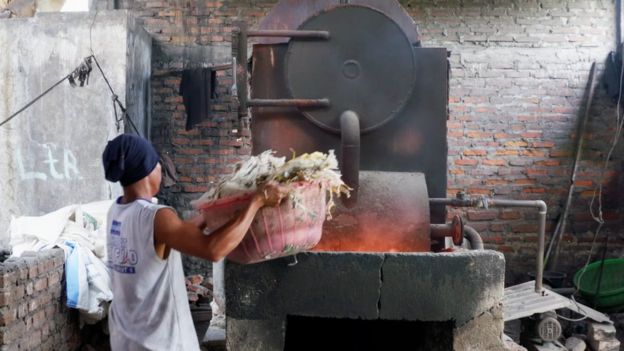
At one tofu factory, plastic is burnt as fuel.
Researchers from IPEN (the International Pollutants Elimination Network) collected free-range chicken eggs at two sites near Surabaya, in East Java.
Testing eggs, the researchers said, was the easiest way to check whether the chemicals known as persistent organic pollutants (POPs) such as dioxins had made it into the food chain.
The most serious reading was taken near a group of tofu factories that burn plastics for fuel, in the village of Tropodo.
The tests found eating one egg would exceed the European Food Safety Authority (EFSA) tolerable daily intake for chlorinated dioxins 70 times over.
Researchers said this was the second-highest level of dioxins in eggs ever measured in Asia - only behind an area of Vietnam contaminated by the chemical weapon Agent Orange.
The eggs also contained toxic flame-retardant chemicals, SCCPs and PBDEs, used in plastics.
One resident in Tropodo said it was known as the "city of smoke".
"We don't need to tell the doctor what our symptoms are... we just tell them that we are from Tropodo and they know right away."
Experts believe eating a few contaminated eggs would not impact health - but long-term exposure could lead to serious problems.
"The results of our research are some of the most shocking we have ever had. In Indonesia, we've never had these results before," explained Yuyun Ismawati, a leading Indonesian environmentalist behind the tests.
Dr Agus Haryono, from the Indonesian Institute of Sciences, said the country's government needed to implement "a proper infrastructure for testing and monitoring POPs [Persistent Organic Pollutants]" to combat the "uncontrolled cross-border plastic trade".
In the first six months of this year, the UK sent 18,000 tonnes of plastic and 55,000 tonnes of paper to Indonesia
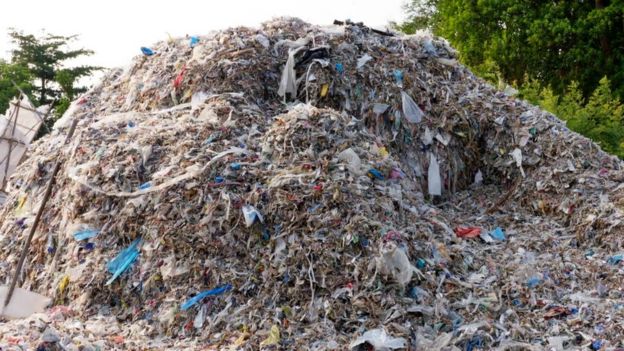
The researchers focused on the area around a paper factory in East Java, where around 40% of its paper is imported. But the paper is arriving contaminated with low quality plastic.
The plastic is then sold to local villagers, many of whom rely on the plastic for their livelihoods.
One so-called "plastic farmer" in the village of Bangun, Supiyati, told the BBC she made a living by searching through plastic waste to sell the better-quality material to plastic factories.
Continue reading this interesting BBC News article clicking here: Indonesia -plastics