Mostrando entradas con la etiqueta Brexit. Mostrar todas las entradas

martes, 15 de diciembre de 2020

Deal or no deal: where is Brexit heading?

 A very interesting podcast about the situation of the Brexit right now and its consequences.

Click here to listen to it: Brexit_podcast

lunes, 16 de noviembre de 2020

Sir John Major's Treasurer's Lecture

 Watch this interesting speech held last November 9th which deals with Brexit and Covid. He seems to be so right!


"Brexit was sold to our electors on false premises..."
"... it will be a painful ball and chain on our national well-being"
"... for the first time in our history, ministers have proposed legislation giving them powers to break the law. This is a slippering slope down which no democratic government should ever travel."
..."this is a wretched betrayal of what our electors were led to believe when they voted for Brexit."
"... the problem is politics."
"...they (ministers) cannot be above the law."

viernes, 31 de enero de 2020

From Brefusal to Brexit (The Guardian)

Read this interesting summary published in today's Guardian:

Timeline

From Brefusal to Brexit: a history of Britain in the EU

After 47 years and 30 days it is all over. As the clock strikes 11pm on Friday, the UK is officially divorced from the EU and will begin trying to carve out a new global role as a sovereign nation. It was a union that got off to a tricky start and continued to be marked by the UK’s sometimes conflicted relationship with its neighbours. Here’s a run-through the beginning, the middle and the end.
Brefusal
The French president, Charles de Gaulle, vetoes Britain’s entry to EEC, accusing the UK of a “deep-seated hostility” towards the European project.
Brentry
Sir Edward Heath signs the accession treaty giving entry to the EEC in an official ceremony that was accompanied by a torch-lit rally, dickie-bowed officials and a procession of political leaders including former prime ministers Harold Macmillan and Alec Douglas-Home.
Lisa O'Carroll
Referendum
The UK decides to stay in the common market after 67% voted "yes". Margaret Thatcher, later to be leader of the Conservative party, campaigned to remain.
'Give us our money back'
Margaret Thatcher negotiated what became known as the UK rebate with other EU members after the "iron lady" marched into the former French royal palace at Fontainebleau to demand “our own money back” claiming for every £2 contributed we get only £1 back” despite being one of the “three poorer” members of the community.
It was a move that sowed the seeds of Tory Euroscepticism that was to later cause the Brexit schism in the party. 
The Bruges speech
Thatcher served notice on the EU community in a defining moment in EU politics in which she questioned the expansionist plans of Jacques Delors, who had remarked that 80% of all decisions on economic and social policy would be made by the European Community within 10 years with a European government in “embryo”. That was a bridge too far for Thatcher.
The cold war ends
Collapse of Berlin wall and fall of communism in eastern Europe, which would later lead to expansion of EU.
'No, no, no'
Divisions between the UK and the EU deepened with Thatcher telling the Commons in an infamous speech it was ‘no, no, no’ to what she saw as Delors’ continued power grab. Rupert Murdoch’s Sun newspaper ratchets up its opposition to Europe with a two-fingered “Up yours Delors” front page.
Black Wednesday
A collapse in the pound forced prime minister John Major and the then chancellor Norman Lamont to pull the UK out of the Exchange Rate Mechanism.
The single market
On 1 January, customs checks and duties were removed across the bloc. Thatcher hailed the vision of “a single market without barriers – visible or invisible – giving you direct and unhindered access to the purchasing power of over 300 million of the world’s wealthiest and most prosperous people".
Maastricht treaty
Tory rebels vote against the treaty that paved the way for the creation of the European Union. John Major won the vote the following day in a pyrrhic victory. 
Repairing the relationship
Tony Blair patches up the relationship. Signs up to social charter and workers' rights.
Ukip
Nigel Farage elected an MEP and immediately goes on the offensive in Brussels. “Our interests are best served by not being a member of this club,” he said in his maiden speech. “The level playing field is about as level as the decks of the Titanic after it hit an iceberg.”
The euro
Chancellor Gordon Brown decides the UK will not join the euro.
EU enlarges to to include eight countries of the former eastern bloc including Poland, Hungary and the Czech Republic.
EU expands again, allowing Romania and Bulgaria into the club.
Migrant crisis
Anti-immigration hysteria seems to take hold with references to “cockroches” by Katie Hopkins in the Sun and tabloid headlines such as “How many more can we take?” and “Calais crisis: send in the dogs”.
 David Cameron returns with reform package.
Brexit referendum

Britain leaves the EU

jueves, 30 de enero de 2020

The Britons getting out before Brexit ‘drawbridge’ goes up

UK nationals rush to settle in Spain before they lose their rights as EU citizens on 31 December

Campaigners for the rights of British nationals in Spain have reported a rise in the number of inquiries from people rushing through plans to establish residency in the country before the Brexit “drawbridge goes up”.
Sue Wilson, the founder of campaign group Bremain in Spain, says now that Brexit is “concrete and is happening” they are seeing evidence of Britons “expediting their plans” for retirement or a career move to Spain.
Under the withdrawal agreement British nationals can settle in another EU member state right up to 31 December and claim lifetime rights as EU citizens.
“We have people inquiring what the rules are and we are saying to people that as long as they move before 31 December they will have the same rights as those of us who are already here. It is in the withdrawal agreement,” says Wilson.
“Even if you haven’t reached pension age and you have paid in for enough years to make you eligible you will have the right to an uprated pension for life under the withdrawal agreement.”
Not all rights are guaranteed and the campaign group British in Europe has urged Brussels and London to secure those that have yet to be negotiated, which include freedom of movement and the right to return to the UK with an EU family member after Brexit. But the rights to study, work and retire remain for those moving before 2021.
We spoke to some who have already taken the plunge.

Andrew Dutton, 51, Elviria, Costa del Sol

Property executive
“I did a spreadsheet at 4am in the morning and concluded that we could probably go now and that’s exactly what we did,” he says.
Andy and his wife sold their house and upped sticks from Manchester to Spain in October.
“We had always planned to retire out here, then Brexit put that into stark relief. The way that had been implemented put the fear of God into us, really, in terms of getting out here,” says Andy.
“I had the vague idea of retiring somewhere between 55 and 60. We have a strict budget and I’ll have to work but we’re glad we did it. We didn’t like the rhetoric and the type of deal people like Dominic Raab was talking about didn’t seem to stack up. There was nobody to talk to – you couldn’t ring the government and ask: ‘Is this the position? Is this cast in stone? Can we trust you?’
“We are not economic migrants. We considered Australia many years ago but in terms of employment it’s more complicated. The freedom of movement is key. You can cross a border into France, Spain without even noticing and you have the ability to work with no questions asked. That’s why we chose to become residents here.
“Emotionally it’s quite difficult. The biggest step has been leaving all the friends and family and you want them here with you. Three months in there are days when you do feel homesick but there is Facetime and Skype.”
But he and his wife have no regrets. “Our fear was the drawbridge would go up and the rights we had pre-Brexit wouldn’t be there.”
(...)                                                                                                 The Guardian, 30 Jan 2020

If you want to read more testimonies, click here: The Britons in Spain
Resultado de imagen de brexit

miércoles, 9 de octubre de 2019

Ireland, Good Friday agreement, Brexit and peace

Peace in Ireland is precious. Brexit has made us forget that. 
Jonathan Freedland has written a very interesting and thought-provoking article about the dangers of Brexit, regarding the Irish border.
You can read it clicking here:

You have here some extracts of his article:
Boris Johnson’s stance on the Irish border shows his casual disdain for the Good Friday agreement, a fragile accord that ended a bloody war. (...)

It is one of the stranger aspects of the Brexit debate. When the plea is raised to remember the Good Friday agreement, to do nothing that might jeopardise the fragile peace that has held in Northern Ireland for two decades, that plea usually comes in a continental European accent. Of course, Irish politicians have been saying it loudly from the start, but this week it was striking to hear French, German, Dutch or Belgian voices explaining to British TV and radio audiences why the EU couldn’t possibly accept Boris Johnson’s revised Brexit plan because of the risk it posed to peace in a corner of the United Kingdom where a bloody conflict had raged within recent memory. (...)

Still, amnesia and imperiousness do not alone explain this carelessness towards the life-saving document that is the Good Friday agreement. It may seem a matter of apple-pie consensus now, but the peace process and eventual accord faced strident opponents – today’s arch-Brexiteers among them. The DUP was hostile throughout, of course, but so was one Michael Gove, author of a 58-page jeremiad that compared the agreement to Nazi-era appeasement, describing it as a “humiliation” and “moral stain”. Is it a surprise that this government is risking a return to violence in Ireland when it includes those who loathed the very pact that ended it? (...)

It points to a glum truth about Brexit. Thanks to the complicated, bloody history and geography of these islands, leaving the EU, including the single market and customs union, means constructing a border between the EU and the UK in the one place where it’s just too dangerous to have such a border. Put another way, leaving the EU would be easier for every other member state than it would be for us. We should not be the first country to leave the European Union. In fact, given our past – our pain and the peace that ended it – we should be the very last.

lunes, 21 de enero de 2019

EU citizen registration in UK could become 'new Windrush', say migration experts

Migration experts have warned that the post-Brexit system for registering EU citizens living in the UK could become a new “Windrush scandal” as the scheme to register an estimated 3.5 million EU citizens living in the UK begins.
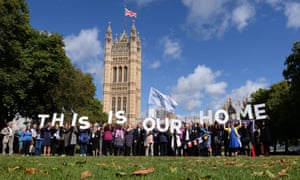
EU citizens holding up a banner in London in a bid to guarantee their post-Brexit rights.
From Monday, the third phase of testing will open to EU residents in the UK, who will be able to register for the new post-Brexit “settled status”. The Home Office is extending its live trial to all EU citizens who hold a valid passport and any non-EU citizen family members who hold a valid biometric residence card.
Critics have warned that thousands could be left without legal status to remain in the UK if applications are not processed quickly and effectively.
Maike Bohn, founder of the3million which campaigns for EU citizens in the UK to retain their existing rights after Brexit, warned trust in the government was low.
“The Windrush people trusted the Home Office and many of them got deported because they were citizens but couldn’t prove it,” she said.
The expansion of the scheme follows two “private” test phases. The second phase saw 29,987 applications submitted with 27,211 decisions made. Of those, no cases were refused. However, the second phase was open to 250,000 people in selected universities, health and social care bodies.
The Home Office said 70% of applicants had been granted settled status with the remaining 30% granted pre-settled status, which is given to those who have been in the country for fewer than five years. There was positive feedback from 77% of applicants.
The immigration minister, Caroline Nokes, said: “From the very beginning we have been clear that securing the rights of EU citizens living in the UK is our priority.
“The report into the second private test phase of the EU settlement scheme shows clearly that we are well on track to deliver a system that will make it easy and straightforward for EU citizens to obtain status once we have left the EU.
“We are now in a position to proceed with the wider public testing of the scheme, which will provide us with further valuable insight before the full launch of the system by the end of March. We are grateful to those individuals and organisations that have participated in the testing so far.”
The rollout comes weeks after a series of bugs were exposed in the phone app, which does not work on iPhones, including complaints that the passport recognition function did not work on all Android models.
Politicians, migrant thinktanks and charities have warned the UK could face “another Windrush” if the settled status scheme fails.
Chai Patel, legal policy director at the joint council for welfare of immigrants, said: “EU citizens who do not pay to apply for settled status by 2021 will lose their right to live in the UK and become undocumented.
“This is a major obstacle in the way of achieving the government’s promise that every EU national currently in the UK will be welcome after Brexit. By charging a fee and by setting a time limit for applications the government is making it certain that some people will not get settled status.
“And with 3 million to 4 million people needing to register, that means creating tens or hundreds of thousands of undocumented migrants overnight. The poor, the elderly, [and] those with illnesses or disabilities will be particularly affected as the government is failing to set aside enough resources to help them.
“We therefore urge the government to do everything in its power to make sure everyone’s rights are protected after Brexit. Instead of creating a system that defaults to removing rights if a person does not pay for an application, the government should today grant a free and permanent legal right to stay to all EU nationals resident in the UK.
“The Home Office should then provide a free and simple process by which people can obtain documents proving that right.”
Jill Rutter, director of strategy for British Future and co-author of the report, said: “The Home Office must invest in getting the EU settlement scheme right from the start. Failure to do so could cause massive problems in years to come, on a far bigger scale than the ‘Windrush scandal’.
“The application system should work simply and efficiently for the vast majority of EU citizens. But there will always be more complex cases where people find it harder to navigate the system or to prove their residency – and the sheer scale of this task means even a low rate of failure equates to tens of thousands of people.
“The Home Office needs to make sure that people hear about the scheme, that it works well and that errors are remedied quickly when they are made. It must also overcome a legacy of mistrust created by the previous permanent residency scheme.
“This is an important test for the Home Office. The stakes are high. Get it right and the UK sends a strong message that EU citizens are welcome and the government is in control. Get it wrong and the consequences are dire.”
Ed Davey, Liberal Democrat home affairs spokesman, said: “No one seriously believes that the Home Office will be able to grant settled status to everyone who’s eligible within two years. Thousands will be left effectively undocumented and subject to Theresa May’s hostile environment.
“Liberal Democrats demand better for the Europeans who’ve made their lives here and contribute so much to our economy, our public services and our society. They must not become the victims of a new Windrush scandal.”
The Guardian 21 Jan 2019