viernes, 7 de diciembre de 2018

Teacher Man: questions for chapter 12


CHAPTER 12
Answer the following questions:
-          In Stuyvesant something changes in his teaching life for the first time. What is it? How does it affect him?
-          His professional life improves, but he can’t be completely happy. What happened in his private life?

jueves, 6 de diciembre de 2018

Luxembourg to become first country to make all public transport free

Government seeks to prioritise environment and end some of world’s worst traffic congestion

Luxembourg City, the capital of the small Grand Duchy, suffers from some of the worst traffic congestion in the world.
Fares on trains, trams and buses will be lifted next summer under the plans of the re-elected coalition government led by Xavier Bettel, who was sworn in for a second term as prime minister on Wednesday.
Bettel, whose Democratic party will form a government with the leftwing Socialist Workers’ party and the Greens, had vowed to prioritise the environment during the recent election campaign.
On top of the transport pledge, the new government is also considering legalising cannabis, and introducing two new public holidays.
Luxembourg City, the capital of the small Grand Duchy, suffers from some of the worst traffic congestion in the world.
It is home to about 110,000 people, but a further 400,000 commute into the city to work. A study suggested that drivers in the capital spent an average of 33 hours in traffic jams in 2016.
While the country as a whole has 600,000 inhabitants, nearly 200,000 people living in France, Belgium and Germany cross the border every day to work in Luxembourg.
Luxembourg has increasingly shown a progressive attitude to transport. This summer, the government brought in free transport for every child and young person under the age of 20. Secondary school students can use free shuttles between their institution and their home. Commuters need only pay €2 (£1.78) for up to two hours of travel, which in a country of just 999 sq miles (2,590 sq km) covers almost all journeys.
Now, from the start of 2020 all tickets will be abolished, saving on the collection of fares and the policing of ticket purchases.
The policy is yet to be fully thought through, however. A decision has yet to be taken on what to do about first- and second-class compartments on trains.
Bettel only just scraped back into government in the recent election. Opinion polls before October’s poll had indicated that the Christian Social People’s party (CSV) – led for 19 years by the European commission president, Jean-Claude Juncker – would end Bettel’s five years as prime minister.
The CSV, however, lost seats, while the Greens gained three seats. The result gave the coalition 31 seats in the 60-seat chamber.
The policy of the new government that has caused the most debate, however, has been that of legalising the purchase, possession and consumption of cannabis for recreational use.

lunes, 3 de diciembre de 2018

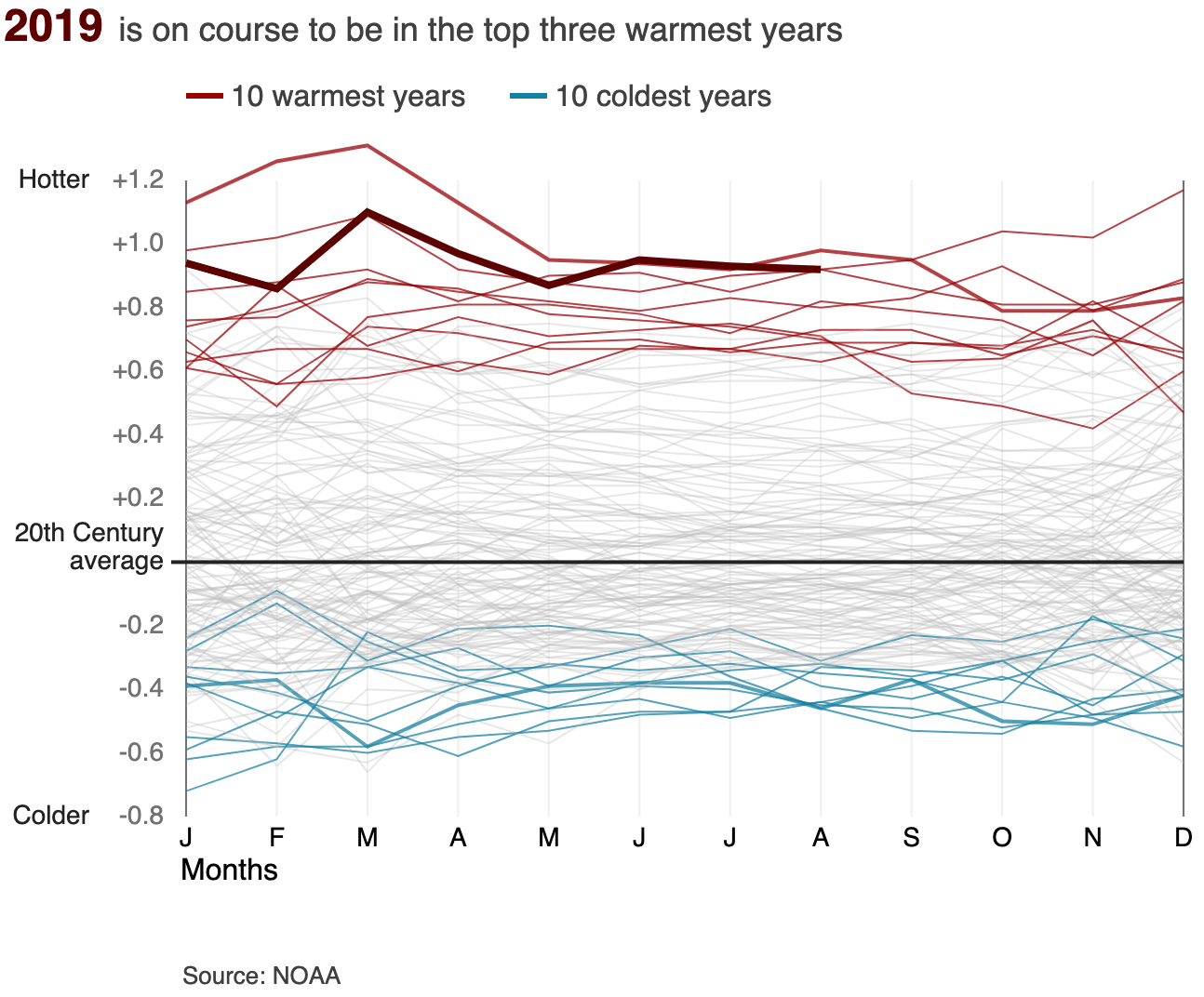
Climate change: Where we are in seven charts and what you can do to help

Read this interesting article about climate change.

1. The world has been getting hotter


2. The year 2018 set all sorts of records

This year saw record high temperatures in many places across the world amid an unusually prolonged period of hot weather.
Large parts of the northern hemisphere saw a succession of heatwaves take hold in Europe, Asia, North America and northern Africa - a result of strong high pressure systems that created a "heat dome".
Over the period shown on the map below (May to July 2018), the yellow dots show where a heat record was broken on a given date, pink indicates places that were the hottest they had ever been in the month shown, and dark red represents a place that was the hottest since records began.

Read here the whole BBC-news article:


sábado, 1 de diciembre de 2018

Teacher Man, part 2

You can read here the questions for chapters 9 - 11. You have to answer them before our class next Tuesday when we'll discuss them. Enjoy it!


TEACHER MAN  -  Part 2

CHAPTER 9
1.     Explain why he left McKee Vocational and Technical High School and summarize his experience as a university adjunct lecturer.
2.      Why, in your opinion, didn’t he succeed when the told his university students “You have a right to think for yourselves”?
3.      Why did he give up his college career?
4.      What do we know about his family life so far? What is going on at home?
5.      What did he use the parts of a ballpen to explain?
6.      What are the problems underlying behind Hector’s incident?

CHAPTER 10
7.      What is a melting-pot school?  (Seward Park High School)
8.      What are the main problems of the students who attend this kind of schools?
9.      How did McCourt face the problem?


CHAPTER 11
10.  What challenges McCourt in his classes?
11.  Who is Andrew? What’s the connection of this kid with the teacher’s past?
12.  Why did Frank go to the psychologist? Was it positive for him?
13.  In your opinion, what does he think of psychologists after his experience?
14.  Why didn’t Ben Boom Boom react when McCourt made him fall in the classroom?
15.  How many times did he go to Dublin? How different was each occasion from the previous one?
16.  Why was he fired from the last school?

jueves, 29 de noviembre de 2018

WOULD - different uses and key to exercises


                  WOULD

1. To express unlikely or unreal situations:
Ex. We wouldn’t be here if we had taken the right train.

2. To express a past hypothesis or regret:
Ex. I wouldn’t have failed if I had worked hard.

3. To express habitual past with active verbs:
Ex. As a child, I’d walk to school every day.

4. To express the future in the past:
Ex. She met the man she would one day marry.

5. To express a refusal:
Ex. The car wouldn’t start.

6. To give advice:
Ex. If I were you, I’d stop smoking now.

7. To introduce cautious opinions:
Ex. I’d say / I’d imagine he is a good colleague.

8. To make polite requests, and express wants and preferences:
Ex. Would you mind opening the window?
I’d like to leave now. I’d prefer to go by train.

9. Past of will (often in reported speech):
Ex. She said she would come.

Key to exercises:


Togolese innovators turn the world's junk into robots

Togo imports an estimated 500,000 tonnes of e-waste a year, some of it can be a health hazard, but it also inspires local innovators and provides jobs.
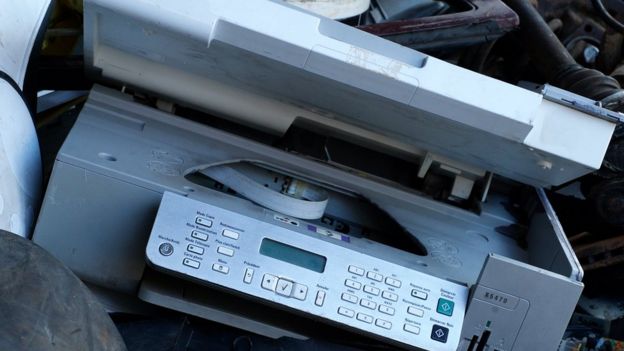
A printer at a landfill
It looks like a spider and it moves like one, but this robot creature cannot just be dismissed as a toy.
It is also a symbol of the digital revolution brewing in one of West Africa's smallest countries.
"I made this from a [discarded] 3D printer," Ousia Foli-Bebe says, pointing as his robotic arachnid.
"The plastic retrieved from the printer became the arms and legs. And I made a 3D printer as well from e-waste. I actually learned how to make the printer from the internet," he adds.
Mr Foli-Bebe takes the robot spider into schools hoping to interest the students in science and recycling.
"My hope is to make a science kit so that they can begin to make their own things and solve the problems of this community," the inventor says.
His Ecotec lab is situated in Amadanhome on the outskirts of Togo's capital, Lomé.
It is a modest space, with a blackboard dominating one wall and a 3D printer next to the opposite wall.
The 29-year-old is one of a growing number of young entrepreneurs who see all the e-waste imported by Togo as an opportunity.
Local environmental body E-Waste Centre estimates that 500,000 tonnes come into the country every year.
Outside his lab is a motley collection of old televisions and other used electronic goods spread over a tennis-court-sized dumpsite.
Conveniently, Mr Foli-Bebe shares the site with an e-waste recycler, giving easy access to parts for his inventions.
He admits he has learned a lot about recycling from others such as Gnikou Afate, who is credited with having made the first 3D printer in Togo.
So impressive was Mr Afate's homemade printer that it took first place at the Barcelona Fabrication Technology conference in 2015.
The soft-spoken 39-year-old innovator, who previously used to collaborate with another technology hub called Woelab, one of the best in town, recently started his own lab and operates out of a small workspace next to his house.

The new 'goldmine'

"At first, electronic waste was a plague - that's how we used to describe it," Mr Afate says.
"Our streets were littered with old computer bodies rotting away. But today that problem has turned into an opportunity. E-waste could be described as a goldmine."
Only 41 countries in the world, , most of them European, collect statistics on e-waste, according to The Global E-waste Monitor report.
In 2016 people around the world generated about 44 million tonnes of electronic waste, the report said.
Old mobile phones, laptops, TVs and generators jammed inside vans and lorries form part of what comes through Lomé's port.
The vehicles are opened up at a market next door to the port and the buyers gather round.
The rising demand for technology has created a market for people who want to buy second-hand electronics at bargain prices.
But it is not just demand for these products that is encouraging their arrival. It is also the inadequate recycling available in richer countries.
Organisations such as the Basel Action Network are raising concerns that Western countries are simply not handling their own electronic waste effectively, leaving it destined to end up on cargo ships bound for West Africa, among other places.
"The world does not know what to do with the e-waste that it is producing. Africa offers the best environment for dumping," says activist Sena Alouka from Youth for the Environment Togo.
"We have a weak regulatory framework, weak institutions and corruption also aids in the movement of e-waste. We need to emulate Thailand who threatened to use her military to ban the import of electronic waste."
While it is not against international law to export used goods to other countries, the problem comes about if these goods no longer work as outlined by treaties such as the Basel and Bamako conventions.
The Bamako convention, which came into force in 1998, commits African nations to banning the importation of hazardous waste, including radioactive material.
It also encourages countries on the continent to adopt legislation to control the importation of near-end-of-life or unwanted equipment by designating such equipment as hazardous waste.
"Think of a set of televisions - they have cadmium, lead and beryllium. All those are toxic and very dangerous to humans and to the environment," Mr Alouka says.
"They can find their way to aquifers, spill into the ocean. We eat the fish. They contain mercury and much more. [It is] very dangerous for our health. Especially to our children."
It is, however, a challenge to regulate electronic waste management because many people earn a living from it.
"If you look at the types of waste which arrives here, a lot of it is highly dangerous and toxic so we should really evaluate the economic impact that it could have on our environment," Hervé Tchamsi from the E-Waste Centre, a recycling business, says.
His team tries to minimise their exposure to the hazardous materials in the e-waste and he hopes this higher standard will one day be the norm in Togo.

Sent back to Europe

But for now, what they cannot repurpose, they export back to Europe, where it originally came from. An irony that is not lost on Mr Tchamsi.
"Here are the TVs that contain the toxic materials. We pay to send these back to Belgium for recycling - because we do not have the capacity here to recycle the e-waste in a safe way," he explains.
In a country with limited job opportunities for its young people there is huge potential for this industry.
Innovators and entrepreneurs alike are trying to come up with solutions that harness that potential and mitigate the dangers.
By Waihiga Mwaura
BBC NEWS
You can now watch some interesting videos and pictures published by BBC News clicking here: